
This guide gets retirement accounts explained in one place: what a 401(k), Roth 401(k), traditional IRA, Roth IRA and HSA each do, how they are taxed, and how much you can put in each one in 2026. Most people only need two or three of these accounts; the hard part is knowing which ones and in what order to fund them. By the end you will have a simple funding order you can follow for years.
Table of Contents
Retirement accounts explained: the big picture
A retirement account is not an investment in itself. It is a tax wrapper: a container with special tax rules that you fill with investments such as stock funds, bond funds or cash. The account decides how your money is taxed; the investments inside it decide how much it grows.
Every account on this page answers the same question in a different way: when do you pay tax? There are really only two answers.
- Pay tax later (traditional / pre-tax): your contribution lowers taxable income today, the money grows tax-deferred, and withdrawals in retirement are taxed as ordinary income.
- Pay tax now (Roth): you contribute money that has already been taxed, it grows tax-free, and qualified withdrawals in retirement are tax-free.
The HSA is the odd one out. Used for qualified medical costs, it can skip tax on the way in and on the way out, which is why many planners treat it as a retirement account in disguise.
The second dimension is who offers the account. Workplace plans like the 401(k) come through your employer and have higher limits. Individual accounts like IRAs you open yourself at a brokerage, bank or robo-advisor. Keep those two ideas in mind, tax timing and who provides the account, and every option below slots into place.
Time matters as much as the account type. Tax-sheltered growth lets returns build on returns for decades, which is the effect described in our guide to how compound interest works. Starting at 25 instead of 35 can matter more than picking the perfect account.
What are the main types of retirement accounts?
For most US workers, five accounts cover nearly every situation, so that is where we start with retirement accounts explained one by one. Others exist (403(b) for schools and nonprofits, 457(b) for government workers, the Thrift Savings Plan for federal employees, SEP and SIMPLE IRAs for small businesses and the self-employed), but they work much like the five below.
Traditional 401(k)
An employer plan funded through payroll deductions. Contributions are pre-tax, so a $500 contribution reduces your taxable pay by $500. Many employers add a matching contribution, such as 50 cents per dollar up to 6% of salary. Withdrawals in retirement are taxed as income.
Roth 401(k)
Same plan, same limit, different tax timing. You contribute after-tax pay, and qualified withdrawals (generally after age 59½ and at least five years after your first Roth contribution to the plan) are tax-free. Not every employer offers it. Since 2024, Roth 401(k) balances are no longer subject to required minimum distributions during the owner’s lifetime.
Traditional IRA
An individual retirement arrangement you open yourself. Anyone with earned income (or a spouse with earned income) can contribute. Whether the contribution is tax-deductible depends on your income and whether you or your spouse are covered by a workplace plan.
Roth IRA
The individual version of Roth saving. No deduction now, tax-free qualified withdrawals later, and no required minimum distributions for the original owner. You can withdraw your own contributions (not earnings) at any time without tax or penalty, which makes it unusually flexible. Eligibility phases out at higher incomes.
Health Savings Account (HSA)
Available only if you are covered by a qualifying high-deductible health plan (HDHP). Contributions are deductible (or pre-tax through payroll), growth is tax-free, and withdrawals for qualified medical expenses are tax-free. After 65, non-medical withdrawals are taxed as income, like a traditional IRA, but without the 20% penalty that applies before 65.
What is the 401(k) contribution limit for 2026?
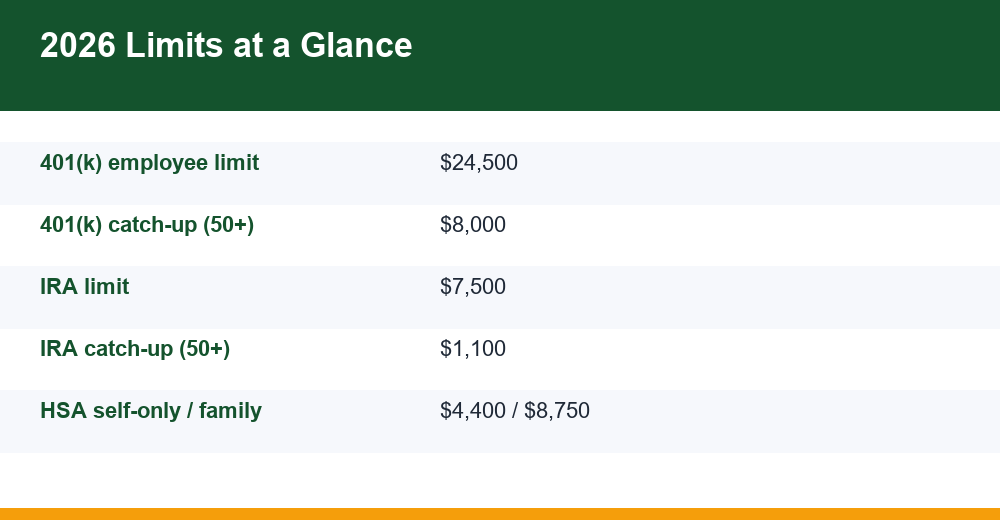
The IRS adjusts most limits each year for inflation. For 2026, the 401(k) employee limit rose to $24,500 and the IRA limit to $7,500, according to the official IRS announcement. HSA limits are set separately, under Revenue Procedure 2025-19. Here are the numbers that matter most with every major account side by side.
| Account | 2026 limit (under 50) | Catch-up | Tax on the way in | Tax on the way out |
|---|---|---|---|---|
| Traditional 401(k), 403(b), governmental 457(b), TSP | $24,500 | +$8,000 at 50+; +$11,250 instead at ages 60-63 | Pre-tax | Taxed as income |
| Roth 401(k) | Shares the $24,500 limit | Same as above | After-tax | Tax-free if qualified |
| Traditional IRA | $7,500 (combined with Roth IRA) | +$1,100 at 50+ | Deductible if eligible | Taxed as income |
| Roth IRA | $7,500 (combined with traditional IRA) | +$1,100 at 50+ | After-tax | Tax-free if qualified |
| HSA | $4,400 self-only / $8,750 family | +$1,000 at 55+ | Pre-tax or deductible | Tax-free for medical costs |
A few details trip people up:
- The $24,500 limit is per person, not per plan. If you have two jobs with two 401(k)s, your combined employee deferrals still cannot exceed it.
- Traditional and Roth 401(k) contributions share one limit. So do traditional and Roth IRA contributions.
- Employer matching contributions do not count against your $24,500. A separate, much higher overall cap covers employee plus employer money combined.
- Your IRA contribution cannot exceed your taxable compensation for the year. A spouse with little or no income can still use a spousal IRA if you file jointly.
- Employer HSA contributions count toward the HSA limit. If your employer puts in $1,000 on self-only coverage, you can add up to $3,400.
One newer rule for higher earners: starting in 2026, if your prior-year FICA wages from the employer sponsoring your plan exceeded $150,000, any 401(k) catch-up contributions you make must go in as Roth. If your plan has no Roth option, it may not allow those catch-ups at all, so check with your plan administrator.
Roth IRA vs traditional IRA: what’s the difference?
Both IRAs share the same $7,500 limit and the same menu of investments. The difference is tax timing and who qualifies.
| Feature | Traditional IRA | Roth IRA |
|---|---|---|
| Tax break | Possible deduction now | Tax-free withdrawals later |
| Income limit to contribute | None | Phases out: $153,000-$168,000 single; $242,000-$252,000 married filing jointly (2026 MAGI) |
| Deduction limit | Phases out if you or a spouse have a workplace plan | Not applicable |
| Early withdrawal of contributions | Taxed, plus 10% penalty before 59½ unless an exception applies | Contributions come out tax- and penalty-free any time |
| Required minimum distributions | Yes, currently starting at age 73 | None for the original owner |
For traditional IRA deductions in 2026, a single filer covered by a workplace plan gets a full deduction below $81,000 of modified AGI, phasing out completely at $91,000. For married couples filing jointly where the contributing spouse is covered, the range is $129,000 to $149,000. If neither spouse has a workplace plan, the deduction is available at any income.
How to choose between them
The rule of thumb: compare your tax rate today with your expected rate in retirement. If you are early in your career or in a low bracket, Roth usually wins, because you lock in today’s low rate. If you are in your peak earning years and expect a lower bracket later, traditional often wins.
When you genuinely cannot tell, splitting contributions between both gives you tax flexibility later. Having some tax-free and some taxable buckets in retirement lets you manage your taxable income year by year.
If your income is above the Roth IRA range, the so-called backdoor Roth (a nondeductible traditional IRA contribution followed by a conversion) is legal but has tax traps if you hold other pre-tax IRA money, because of the pro-rata rule. Read the IRS rules or get professional help before trying it.
Can you have a 401(k) and an IRA at the same time?
Yes. The 401(k) and IRA limits are completely separate, so in 2026 someone under 50 could put $24,500 into a 401(k) and another $7,500 into an IRA, for $32,000 of their own money, before any employer match.
What a workplace plan changes is not whether you can contribute to an IRA, but whether a traditional IRA contribution is deductible. If your income is above the deduction range, you can still contribute, but the money goes in after-tax. In that case a Roth IRA, if you qualify, is usually the better choice.
Having both is often a smart combination:
- The 401(k) gives you payroll automation, a higher limit and the employer match.
- The IRA gives you a wider choice of low-cost funds and, with a Roth, tax-free income later.
- Together they let you mix pre-tax and Roth money for tax flexibility in retirement.
You can add an HSA on top of both if you are enrolled in an eligible high-deductible plan. All three limits stack: these are separate buckets, not one shared allowance. If you only remember one point from having retirement accounts explained, make it this one.
401(k) or Roth IRA first? A simple funding order
With the retirement accounts explained, the next question is where each extra dollar should go. This order works for most people and is easy to remember: match, then IRA, then max.
- Build a small emergency cushion. Even one month of expenses keeps a surprise bill from turning into a 401(k) withdrawal with taxes and a penalty.
- Contribute enough to get the full employer match. A 50% or 100% match is an instant return no investment can promise. Never leave it on the table.
- Pay off high-interest debt. Credit card balances at 20% or more usually cost more than any expected investment return.
- Fund an IRA, often a Roth, up to $7,500. You usually get more investment choice and lower costs than in many workplace plans.
- Fund an HSA if you have an eligible health plan. Its tax treatment is the best of any account when used for medical costs. Some people put this before the IRA.
- Go back and raise 401(k) contributions toward $24,500.
- Beyond that, use a regular taxable brokerage account.
There are sensible exceptions. If your 401(k) offers very low-cost index funds, maxing it before the IRA is fine. If you earn too much for a direct Roth IRA contribution, the 401(k) may simply be the main tool. If your plan has no match, you can start directly at step three.
Inside each account, keep investing simple. A broad, low-cost fund often does the job well; see our guide to index funds for beginners for how they work and what to compare. Many 401(k)s also offer target-date funds, which shift toward bonds automatically as you get older.
If you are starting from zero, our walkthrough on how to start investing covers opening your first account and choosing an amount you can sustain. Raising your contribution by 1% each year, or with each raise, is a painless way to climb toward the limits.
What happens to your 401(k) if you change jobs?
Your money does not disappear when you leave. Your own contributions are always yours. Employer contributions are yours once they are vested; check your plan’s vesting schedule, because leaving a few months early can forfeit unvested match.
After you leave, you typically have four options:
| Option | Good when | Watch out for |
|---|---|---|
| Leave it in the old plan | The plan has low fees and good funds | Small balances may be cashed out or moved to an IRA by the plan |
| Roll into new employer’s plan | You like having everything in one place | New plan must accept roll-ins; check its fees |
| Roll into an IRA | You want more fund choice and control | Pre-tax IRA money can complicate backdoor Roth moves |
| Cash out | Rarely a good idea | Income tax, usually a 10% penalty before 59½, lost growth |
If you move the money, ask for a direct rollover, where the old plan sends the funds straight to the new plan or IRA. If the check is made out to you instead, the plan must withhold 20% for taxes, and you have 60 days to deposit the full amount, including replacing that 20% from other savings, or the shortfall is treated as a taxable distribution.
Roth 401(k) money should go to a Roth IRA or another plan’s Roth account, and pre-tax money to a traditional IRA or a pre-tax plan account, so the tax treatment stays intact.
Common mistakes that cost savers money
Most retirement setbacks come from a handful of avoidable errors rather than bad investment picks.
- Not contributing enough to get the match. This is one of the most common and most expensive mistakes.
- Leaving contributions in cash. Money sent to an IRA can sit uninvested in a settlement fund until you choose an investment. Check that it is actually invested.
- Cashing out when changing jobs. Taxes and penalties can take a large share of a small balance, and the lost decades of growth cost far more.
- Ignoring fees. A 1% annual fee versus 0.1% compounds into a big difference over 30 years.
- Over-contributing. Going over the IRA limit, or contributing to a Roth IRA above the income limit, triggers a 6% excise tax each year the excess stays in the account until you correct it.
- Forgetting beneficiaries. The beneficiary form on each account generally overrides your will. Update it after marriage, divorce or a birth.
Finally, review your setup once a year, ideally when the IRS publishes new limits each autumn. Five minutes of checking contribution rates, beneficiaries and fund choices keeps the whole system working. That habit, more than any clever strategy, is what turns retirement accounts explained on paper into real savings. This article is educational and not personalized financial advice.
Frequently Asked Questions
What are the main types of retirement accounts?
The main types for US workers are the traditional 401(k), the Roth 401(k), the traditional IRA, the Roth IRA and the health savings account (HSA). Similar workplace plans include the 403(b), 457(b) and Thrift Savings Plan, while self-employed people can use SEP or SIMPLE IRAs. Each one differs in who offers it, its yearly limit and when you pay tax.
What is the 401(k) contribution limit for 2026?
For 2026, the IRS lets employees contribute up to $24,500 to a 401(k), 403(b), governmental 457 plan or the Thrift Savings Plan. Workers aged 50 and older can add an $8,000 catch-up, and those aged 60 to 63 can add up to $11,250 instead. Employer matching contributions do not count toward the $24,500 employee limit.
Can I have a 401(k) and an IRA at the same time?
Yes. The limits are separate, so in 2026 someone under 50 can contribute $24,500 to a 401(k) and $7,500 to an IRA. Being covered by a workplace plan can reduce or eliminate the tax deduction for a traditional IRA at higher incomes, but it never stops you from contributing. Roth IRA eligibility depends on income and filing status, not workplace coverage.
What happens to my 401(k) if I change jobs?
Your contributions and vested employer money stay yours. You can usually leave the account in the old plan, roll it into your new employer’s plan, roll it into an IRA or cash it out. A direct rollover avoids the 20% mandatory withholding, while cashing out typically triggers income tax and, before age 59½, a 10% penalty.