Index funds for beginners are popular for a simple reason: they let you own a large slice of the stock market for a very small yearly fee, with no stock picking involved. Simple doesn’t mean you have no choices to make, though. This guide goes through the seven decisions new investors actually face, from what a fee costs in real dollars to which account the fund should go in.
Table of Contents
1. What is an index fund and how does it work?
An index fund is a mutual fund or exchange-traded fund built to match the performance of a market index, such as the S&P 500. It does not try to beat the index. The fund simply buys the same stocks or bonds the index contains, in about the same proportions.
This is called passive management. Nobody at the fund is researching which companies will do best next year. When the index adds or drops a company, the fund follows. Because there is so little work involved, costs stay low, and low costs are the main reason index investing has held up well over time against many actively managed funds.
The SEC’s investor education materials make a practical point worth remembering: if two funds hold the same investments and perform the same, the one with lower costs generally leaves more money for the investor. That single idea explains most of what matters when you compare index funds.
Not every “index” fund is plain vanilla
Traditional index funds track broad, well-known market benchmarks. Newer products track custom indexes built around themes, factors or formulas, and some use derivatives or leverage. These can behave very differently from a broad market fund. The sensible choice among index funds for beginners is a fund that tracks a broad, widely followed index.
- Broad stock index: S&P 500, total U.S. market, total world market
- Broad bond index: total U.S. bond market
- Narrow or custom index: a single sector, theme or rules-based “smart beta” strategy (riskier and usually pricier)
- Leveraged or inverse index funds: built for short-term trading, not for buy-and-hold beginners
2. Expense ratios in real dollars
The expense ratio is the yearly fee a fund charges, shown as a percentage of what you have invested. You never get a bill for it. The fund takes it out of its assets, which is why many investors never notice it. Converting it into dollars shows what you are really paying.
| Expense ratio | Yearly cost on $10,000 | Yearly cost on $100,000 |
|---|---|---|
| 0.03% | $3 | $30 |
| 0.10% | $10 | $100 |
| 0.50% | $50 | $500 |
| 1.00% | $100 | $1,000 |
A few dollars a year sounds trivial, but the gap widens because fees come out of money that would otherwise keep growing. The illustration below assumes $10,000 invested once for 30 years at a hypothetical 7% gross annual return. It is not a forecast, and real returns vary year to year.
| Annual fee | Approx. value after 30 years | Approx. lost to fees and missed growth |
|---|---|---|
| 0.00% | $76,100 | none |
| 0.03% | $75,500 | about $600 |
| 0.50% | $66,100 | about $10,000 |
| 1.00% | $57,400 | about $18,700 |
The math behind this is the same force you rely on for growth, explained in our guide on how compound interest works. Fees compound too, but against you. With a 1% fee, roughly a quarter of the potential ending balance in this example never reaches the investor.
What is a good expense ratio for an index fund?
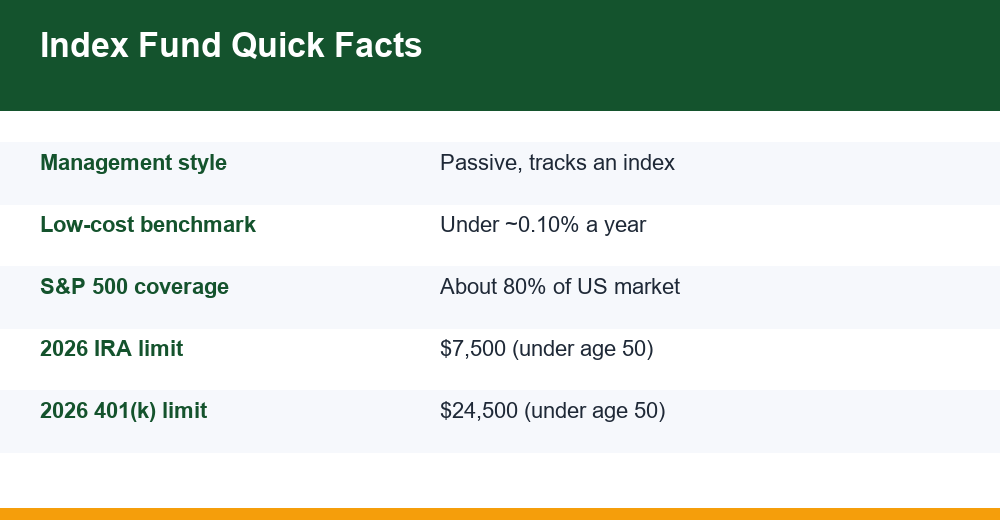
For a broad U.S. stock index fund, a common rule of thumb is under about 0.10%. Many large S&P 500 and total market funds now charge between 0% and 0.05%. International and bond index funds often cost a bit more and still count as cheap. If a fund labelled “index” charges 0.50% or more, find out what you are getting for the extra cost before you buy.
Also look at costs outside the expense ratio: sales loads, purchase or redemption fees, account maintenance fees and trading commissions. The fund’s prospectus has a fee table near the front that lists them, along with an example of what you would pay over 1, 3, 5 and 10 years.
3. Is an index fund the same as an ETF?
Not exactly. “Index fund” describes the strategy. “ETF” and “mutual fund” describe the wrapper the strategy comes in. Most ETFs track an index, and many index funds are mutual funds, so the two terms overlap without meaning the same thing. Some ETFs are actively managed, so the label alone tells you nothing about the strategy.
| Feature | Index mutual fund | Index ETF |
|---|---|---|
| How it trades | Once a day at closing price (NAV) | All day on an exchange, like a stock |
| Minimum investment | Varies; some have none, some ask $1,000-$3,000 | Price of one share, or less with fractional shares |
| Automatic investing | Easy to set fixed-dollar purchases | Depends on whether your broker supports it |
| Tax efficiency in taxable accounts | Usually good | Often slightly better due to the ETF structure |
| Where you can buy it | Often easiest at the fund company’s own brokerage | Almost any brokerage account |
In practice, an S&P 500 index mutual fund and an S&P 500 ETF from the same company will hold the same stocks and earn nearly the same returns. Choose based on convenience. If you plan to invest a fixed amount every payday, a mutual fund or a broker with automatic fractional ETF purchases makes that easy. If you want to move between brokerages without hassle, ETFs are more portable.
One caution for ETFs: because you buy them on an exchange, use a limit order rather than a market order, and avoid trading in the first and last few minutes of the session, when prices can jump around more. Mutual fund orders don’t have this issue, since everyone gets the same end-of-day price.
4. S&P 500 vs total market: which is better?
This question gets a lot of attention, but the difference is smaller than many people expect. The S&P 500 holds about 500 large U.S. companies. A total U.S. stock market fund holds those same companies plus thousands of mid-size and small ones, often 3,500 or more stocks in all.
Both indexes are weighted by company size, so the biggest firms dominate either way. According to S&P Dow Jones Indices, the S&P 500 covers roughly 80% of available U.S. market value, which means a total market fund is mostly the S&P 500 with a small-company slice added on.
| S&P 500 fund | Total U.S. market fund | |
|---|---|---|
| Number of stocks | About 500 | Several thousand |
| Company sizes | Large | Large, mid and small |
| Typical expense ratio | Very low | Very low |
| Long-run returns | Very similar | Very similar, with small differences year to year |
| Availability in 401(k) plans | Very common | Common, less universal |
Our view: either one is a sound core holding. When people weigh up index funds for beginners, the far bigger decisions are how much you save and whether you keep investing through downturns. The total market fund is slightly more diversified. The S&P 500 fund is more widely offered, including in many 401(k) plans. If your workplace plan only offers one of them, use that one.
What neither fund covers is international stocks or bonds. Many investors add a total international fund, or use a single target-date fund that bundles U.S. stocks, foreign stocks and bonds together and shifts toward bonds as the target year approaches.
Don’t buy both an S&P 500 fund and a total market fund thinking you have doubled your diversification. Because the large companies overlap so heavily, the pair behaves almost exactly like either fund on its own.
5. How much money you need to start
Less than you might think. Many brokerages now offer fractional shares, so you can put $25 or $50 into an ETF even if one share costs several hundred dollars. Some index mutual funds have no minimum. Others ask for a first investment of $1,000 to $3,000, so check the fund’s minimum before you choose it.
Before investing anything, make sure the basics are covered. Money for the stock market should be money you won’t need for at least five years. If you are still working through that list, our guide on how to start investing covers the order of steps.
- Pay off high-interest debt such as credit cards first, since few investments reliably earn more than a 20%+ interest rate costs you.
- Keep an emergency fund in an insured savings account.
- If your employer matches 401(k) contributions, contribute at least enough to get the full match.
- Then set up a regular automatic contribution to your chosen index fund.
Small, regular amounts matter more than a big starting sum. Investing a fixed amount on a schedule (often called dollar-cost averaging) also takes away the temptation to wait for the “right” moment, which nobody can predict reliably.
A useful habit with index funds for beginners is to tie contributions to payday and raise the amount whenever your income rises. Even an extra 1% of salary each year adds up over a working career.
6. Which account should hold your index funds
The fund and the account are two separate choices. Many beginners skip the account decision, but it can make a big difference to your taxes. The same S&P 500 fund held in a Roth IRA, a 401(k) or a regular brokerage account will be taxed in three different ways.
| Account | 2026 contribution limit (under 50) | Tax treatment | Best for |
|---|---|---|---|
| 401(k) / 403(b) | $24,500 | Pre-tax or Roth options; grows tax-deferred | Employer match, high savers |
| Traditional IRA | $7,500 | Possible deduction now, taxed on withdrawal | Lowering taxable income today |
| Roth IRA | $7,500 (income limits apply) | After-tax in, qualified withdrawals tax-free | Younger or lower-bracket savers |
| Taxable brokerage | No limit | Dividends and gains taxed yearly or at sale | Goals before retirement, extra savings |
These figures come from the IRS announcement of 2026 retirement plan limits. People 50 and older can add catch-up contributions: $8,000 more in most workplace plans ($11,250 for ages 60 to 63) and $1,100 more in an IRA.
Roth IRA eligibility phases out at higher incomes. For 2026 the range is $153,000 to $168,000 of modified adjusted gross income for single filers and $242,000 to $252,000 for married couples filing jointly. Limits and income ranges are adjusted most years, so check the current figures before you contribute.
For most beginners the order is the 401(k) up to the match, then an IRA, then more in the 401(k) or a taxable account. Our explainer on retirement accounts goes into the trade-offs in more detail.
Watch the menu inside your 401(k)
Workplace plans offer a fixed list of funds. Look for the lowest-cost broad index option, which is often labelled an S&P 500, total market or “institutional index” fund. If the plan has no cheap index fund at all, a low-cost target-date fund is a reasonable fallback.
7. Index funds for beginners: how safe are they?
Index funds remove one specific risk: picking a single company that collapses. They do not remove market risk. If the whole stock market falls, a broad stock index fund falls with it, because it is the market.
That has happened, sometimes sharply. The S&P 500 lost more than half its value from peak to bottom during the 2007-2009 financial crisis and fell roughly a third in a few weeks in early 2020. Investors who held on eventually recovered. Those who sold near the bottom locked in their losses.
- Not insured: mutual funds and ETFs are not bank deposits and are not FDIC-insured, even when bought at a bank.
- Time horizon matters: stock index funds suit goals five or more years away; short-term money belongs in savings or short-term bonds.
- Diversification helps but has limits: owning hundreds of stocks smooths out single-company risk, not economy-wide drops.
- Concentration exists: because the indexes are weighted by size, a handful of the largest companies can make up a big share of an S&P 500 fund.
- Bond index funds move less but can still lose value when interest rates rise.
So are they safe? For long-term goals, a broad, low-cost index fund is one of the more sensible ways to own stocks, because it spreads risk widely and keeps costs down. It is not safe in the sense of guaranteed. The biggest danger for most beginners is their own behaviour, mainly selling in a panic during a downturn.
A simple starter plan
Putting the seven facts together gives a short checklist for index funds for beginners. It is educational, not personalised advice, so adjust it to your own situation or talk to a fee-only adviser if your finances are complicated.
- Confirm you have an emergency fund and no high-interest debt.
- Pick the account first: 401(k) up to the match, then an IRA, then taxable.
- Choose one broad fund: total U.S. market, S&P 500, or a target-date fund.
- Check the expense ratio, ideally under about 0.10% for U.S. stock funds.
- Decide between the mutual fund and the ETF version based on minimums and automation.
- Automate a fixed contribution every payday or month.
- Review once or twice a year, not every day.
Most of the work in index investing happens before you buy: choosing a cheap fund, the right account and a contribution you can sustain. After that, the main job is to stay invested and let time and compounding do the rest.
Frequently Asked Questions
What is an index fund and how does it work?
An index fund is a mutual fund or ETF that copies a market index, such as the S&P 500, by holding the same securities in roughly the same proportions. It does not try to beat the market, only to match it. Because no manager is picking stocks, costs are low, and over long periods investors keep more of the return.
How much money do I need to start investing in index funds?
Often very little. Many brokerages offer fractional shares, so you can buy into an index ETF with $25 or less. Some index mutual funds have no minimum, while others require $1,000 to $3,000 to open a position. Before you start, make sure you have an emergency fund and have paid off high-interest debt.
What is a good expense ratio for an index fund?
For a broad U.S. stock index fund, under about 0.10% a year is a common benchmark, and many large funds charge 0.05% or less. That works out to $5 or less a year per $10,000 invested. International and bond index funds may cost slightly more. Be wary of anything labelled ‘index’ that charges 0.50% or higher.
Are index funds safe for beginners?
They are a sensible choice for long-term goals because they spread your money across hundreds or thousands of companies at low cost. They are not risk-free: when the stock market falls, a stock index fund falls too, and these funds are not FDIC-insured. Use them for money you won’t need for at least five years.