A CD ladder strategy spreads your savings across several certificates of deposit that mature at different times, so part of your money becomes available on a regular schedule while the rest keeps earning a fixed rate. It is a simple way to capture some of the higher yield of longer CDs without locking up every dollar for years. Below you will find a six-step build, a sample $10,000 layout, the main variations, and the rules on maturity, penalties, taxes and insurance.
Table of Contents
How a CD Ladder Strategy Works
A certificate of deposit is a deposit account where you agree to leave your money untouched for a set term in exchange for a rate that is usually fixed. Pulling money out before the term ends normally costs a penalty. That trade-off is the whole reason ladders exist.
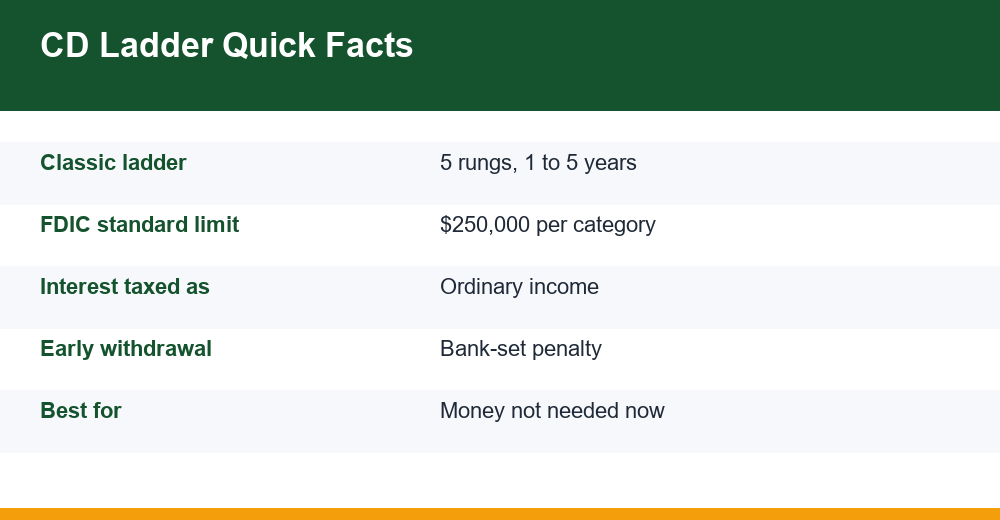
Instead of putting one lump sum into a single CD, you split it into pieces called rungs. Each rung goes into a CD with a different maturity date. In the classic version, you open a 1-year, 2-year, 3-year, 4-year and 5-year CD on the same day.
After the first year, the 1-year CD matures. You can take that cash or roll it into a new 5-year CD. Repeat that every year, and eventually every rung is a 5-year CD, but one of them still matures every twelve months. You end up with longer-term rates and yearly access at the same time.
Why the staggering matters
- Liquidity: a slice of your money comes due on a predictable schedule, so you are rarely more than a year away from penalty-free cash.
- Rate averaging: you are not betting everything on the rate available on a single day. Each renewal locks in whatever the market offers at that time.
- Discipline: money sitting in a CD is harder to spend on impulse than money in checking.
One caveat: a ladder earns the most over short-term options when longer CDs pay more than shorter ones. When the yield curve is flat or inverted, the benefit of stretching out to five years shrinks. Nobody can reliably predict which way rates will move, so a CD ladder strategy is designed to work reasonably in either direction rather than to win a rate forecast.
6 Steps to Build Your CD Ladder
Building a ladder takes an afternoon of comparison shopping and a few account openings. Here is the sequence that keeps it simple.
- Define the job of the money. Decide whether the cash is for a known goal (a car in three years, tuition, a down payment) or long-term savings you simply want to earn more on. The goal sets your longest rung.
- Set aside your emergency cushion first. CDs are a poor home for money you may need next week. Keep that in a liquid account and only ladder what is left over.
- Pick the number of rungs and the spacing. Five rungs one year apart is the textbook layout. Shorter goals call for tighter spacing, such as every three or six months.
- Divide the total evenly. Equal rungs make the reinvestment rhythm easy. Check that each piece meets the minimum deposit of the bank or credit union you choose.
- Shop rates and penalty terms for each maturity. You do not need every CD at one bank. Compare the APY, the early withdrawal penalty and the renewal policy for each term separately.
- Calendar every maturity date. Set a reminder a couple of weeks before each CD matures so you can decide what to do before it automatically renews.
The second step deserves emphasis. If you have not yet built a cash buffer, start with our guide on how to build an emergency fund before tying money up in fixed terms.
How much money do you need to start a CD ladder?
There is no official minimum for a ladder itself. The real floor is the minimum deposit on each CD, and that varies widely: some online banks accept any amount, while others ask for $500, $1,000 or more per certificate. Multiply the minimum by your number of rungs.
A five-rung ladder at a bank with a $500 minimum needs at least $2,500 to get started. If that is more than you have today, you can build the ladder gradually: open one rung now and add another each time you save up the next minimum.
Sample $10,000 Five-Rung Ladder
Here is how a classic ladder looks with $10,000. The amounts are illustrative only. Rates change constantly, so plug in the APYs you actually find when you shop rather than assuming any particular number.
| Rung | Deposit | Initial term | Matures | At maturity |
|---|---|---|---|---|
| 1 | $2,000 | 1 year | End of year 1 | Renew as 5-year CD or spend |
| 2 | $2,000 | 2 years | End of year 2 | Renew as 5-year CD or spend |
| 3 | $2,000 | 3 years | End of year 3 | Renew as 5-year CD or spend |
| 4 | $2,000 | 4 years | End of year 4 | Renew as 5-year CD or spend |
| 5 | $2,000 | 5 years | End of year 5 | Renew as 5-year CD or spend |
If you renew every maturing rung into a new 5-year CD, the ladder is fully built after year five. From then on, all five certificates are long-term CDs, yet one matures every year. That steady state is what most savers aim for.
Adjusting the template
- Goal-dated ladder: if you need $10,000 in three years, you might use 6-, 12-, 18-, 24- and 36-month CDs and simply not renew them as they come due.
- Uneven rungs: if you know a large bill arrives in year two, put more into that rung. Equal amounts are a convenience, not a rule.
- Adding money later: new savings can go into the next rung you open, which slowly grows the ladder without breaking the schedule.
Barbell, Mini-Ladder and No-Penalty Rungs
The five-year staircase is not the only design. Three common variations fit different needs, and you can mix them within one CD ladder strategy.
| Variation | How it is built | Good fit for | Trade-off |
|---|---|---|---|
| Classic ladder | Equal rungs at 1 to 5 years | Long-term savings with yearly access | Five-year commitment per rung once built |
| Barbell | Only short and long CDs, no middle terms | Savers who want quick access plus long-term yield | Middle maturities are skipped |
| Mini-ladder | Terms such as 3, 6, 9 and 12 months | Goals within a year or two | Usually lower yields than long CDs |
| No-penalty rung | One rung in a CD that allows early withdrawal | Extra flexibility in the ladder | Often a lower rate than a standard CD of similar term |
The barbell approach
A barbell keeps weight at both ends: for example, half the money in 6- or 12-month CDs and half in 5-year CDs. The short side gives you frequent maturities and a chance to reinvest if rates rise; the long side locks in a longer rate. You lose the smooth yearly rhythm of a full ladder.
The mini-ladder
A mini-ladder compresses everything into a year or two. It works well when you are saving for something specific and near, like a wedding or a move, and want a bit more than a basic savings account without long lockups.
No-penalty CDs as a safety rung
No-penalty CDs let you withdraw after a short initial waiting period without a fee. Using one as your shortest rung gives you an escape hatch. Read the terms carefully: some require you to withdraw the full balance at once, and the rate is often below that of a standard CD.
What Happens When a CD in Your Ladder Matures
Maturity is the moment the ladder actually earns its keep, so it pays to know the mechanics. Many banks set CDs to renew automatically into a new CD of the same term at whatever rate they offer at that time.
Under the federal Truth in Savings rules (Regulation DD), banks must send advance notice before an automatically renewing CD with a term longer than one month matures. Many banks also offer a grace period after maturity, often around a week to ten days, during which you can withdraw or change the term without a penalty. Grace periods are set by each bank, so check your own account disclosure for the exact window.
Your options at maturity
- Extend the ladder: move the money into a new CD at your longest rung, usually 5 years, to keep the cycle going.
- Shop elsewhere: if another bank pays more, withdraw during the grace period and open the new rung there.
- Use the cash: if the rung was earmarked for a goal, transfer it out and spend it as planned.
- Park it temporarily: move it into a liquid account while you decide. Our comparison of money market accounts vs. savings accounts can help you choose where.
The biggest mistake is doing nothing. If you miss the grace period, the CD may roll into the same term at a rate lower than what you could get by shopping, and moving it afterward can trigger a penalty.
Early Withdrawal Penalties and Taxes
Standard CDs carry an early withdrawal penalty. Federal rules set only a minimum for withdrawals made very soon after opening; beyond that, each institution sets its own penalty and must disclose it before you open the account. It is usually expressed as a number of days or months of interest.
As a rough guide, shorter CDs tend to carry smaller penalties, such as a few months of interest, while 5-year CDs often cost a year or more of interest. These are typical patterns, not rules, and some banks charge more. A large enough penalty can eat into principal if you withdraw soon after opening.
Brokered CDs work differently
CDs bought through a brokerage usually cannot be cashed out with the issuing bank. Instead, you sell them on a secondary market, where you may receive less than you paid if rates have risen since you bought.
How CD interest is taxed
- CD interest is generally taxable as ordinary income in the year it is credited to your account, even if you leave it in the CD.
- Your bank generally reports interest of $10 or more on Form 1099-INT; smaller amounts are still taxable.
- If you pay an early withdrawal penalty, you report the full interest and can deduct the penalty as an adjustment to income on your federal return.
- CDs held inside an IRA follow the IRA’s tax rules rather than these.
A well-planned CD ladder strategy should make penalties rare, since a rung matures every year. If you find yourself breaking CDs often, the ladder is probably too long for your needs.
Are CDs FDIC Insured? Planning Around the Limit
CDs at FDIC-insured banks are covered by deposit insurance, and CDs at federally insured credit unions are covered through the NCUA on similar terms. The standard FDIC amount is $250,000 per depositor, per insured bank, per ownership category, and it includes principal plus accrued interest.
The key point for ladder builders: a CD is a type of deposit, not a separate ownership category. Your CDs, savings and checking held in your own name at one bank are added together and share one $250,000 limit. The FDIC explains the categories in its guide to understanding deposit insurance.
Ways to stay within coverage
- Spread rungs across banks: coverage applies separately at each insured bank, but branches of the same bank do not count separately.
- Use different ownership categories: joint accounts, certain retirement accounts and trust accounts have their own coverage rules.
- Trust accounts: since April 2024, trust deposits are covered up to $250,000 per eligible beneficiary, with a maximum of $1,250,000 per owner per bank.
- Leave room for interest: if you are near the limit, remember that accrued interest counts toward it.
Also confirm the institution is actually insured. Some online platforms partner with banks rather than being banks themselves, so check which bank holds your deposit.
Is a CD Ladder Strategy Worth It vs. High-Yield Savings?
A high-yield savings account pays a variable rate and lets you withdraw anytime. A ladder pays fixed rates and limits access to the rung that is maturing. Neither is always better; it depends on what you value and what rates look like when you shop.
| Factor | CD ladder | High-yield savings |
|---|---|---|
| Rate type | Fixed for each CD’s term | Variable, can change anytime |
| Access to money | One rung at a time, penalty otherwise | Anytime, subject to bank limits |
| If rates fall | Existing rungs keep their rates | Your rate usually drops |
| If rates rise | Only maturing rungs benefit | Your rate may rise |
| Effort | Track maturities and renewals | Very little |
| Insurance | FDIC or NCUA within limits | FDIC or NCUA within limits |
When a ladder tends to make sense
- You have savings you are confident you will not need for at least a year.
- Longer CD rates are meaningfully higher than what savings accounts pay right now.
- You want protection against falling rates on part of your cash.
- You prefer a structure that discourages dipping into the money.
When a savings account is the better home
If the money is your emergency fund, if you may need it on short notice, or if savings accounts are paying about the same as CDs, the flexibility of a high-yield savings account usually wins. Many people use both: an emergency fund in savings and a ladder for surplus cash.
Think of a CD ladder strategy as a tool for money with a time horizon, not a replacement for liquid savings. This article is educational and not personal financial advice; weigh your own situation before committing funds.
Frequently Asked Questions
How does a CD ladder work?
You split your savings into equal parts and open several CDs with staggered maturities, such as one to five years. As each CD matures, you either take the cash or reinvest it in a new long-term CD. Over time, every rung earns a longer-term rate, but one still comes due every year, giving you regular access to money.
Is a CD ladder worth it compared with a high-yield savings account?
It can be when longer CD rates beat savings rates and you will not need the money soon. A ladder locks in fixed rates and protects part of your cash if rates fall. A high-yield savings account is better for emergency funds and money you may need anytime, because you can withdraw without penalties.
What is the penalty for withdrawing a CD early?
Each bank sets its own penalty above a small federal minimum and must disclose it before you open the CD. It is usually a set number of days or months of interest, and longer CDs tend to carry larger penalties. Brokered CDs are generally sold on a secondary market instead, which can mean a loss if rates have risen.
Are CDs FDIC insured?
Yes, CDs at FDIC-insured banks are covered up to $250,000 per depositor, per insured bank, per ownership category, including accrued interest. CDs share that limit with your other deposits in the same category at the same bank, so large ladders are often spread across several banks or ownership categories.