
This is your credit report explained the practical way: one section at a time, in roughly the order you will see it, with a check you can run on every line. Most guides stop at naming the sections. Here you will also learn which of your own statements to compare each entry against, what counts as an error, and how to get a wrong item fixed for free.
Table of Contents
Is a credit report the same as a credit score?
No. A credit report is a record of how you have handled credit: which accounts you have, what you owe, whether you paid on time and who has looked at your file. A credit score is a three-digit number that a scoring model calculates from that record at a given moment.
Think of the report as the ingredients and the score as one recipe made from them. Different scoring models, and different versions of the same model, can produce different numbers from the same report. That is why the score in your banking app may not match the one a mortgage lender pulls.
The free reports you request from the three nationwide bureaus (Equifax, Experian and TransUnion) usually do not include a score at all. That is normal, not a sign that something is missing.
What your report does not contain
People often expect more personal financial detail than a report actually holds. It does not list:
- Your income or salary
- Your bank account balances or savings
- Your investments or other assets
- Your race, religion or national origin
- Your medical records (unpaid medical bills can only show up as collection accounts, subject to the limits covered below)
- Your credit score, in most free versions
Because the report is the raw material, getting your credit report explained, checked and corrected is the most direct way to protect every score built from it.
How often can you get a free credit report?
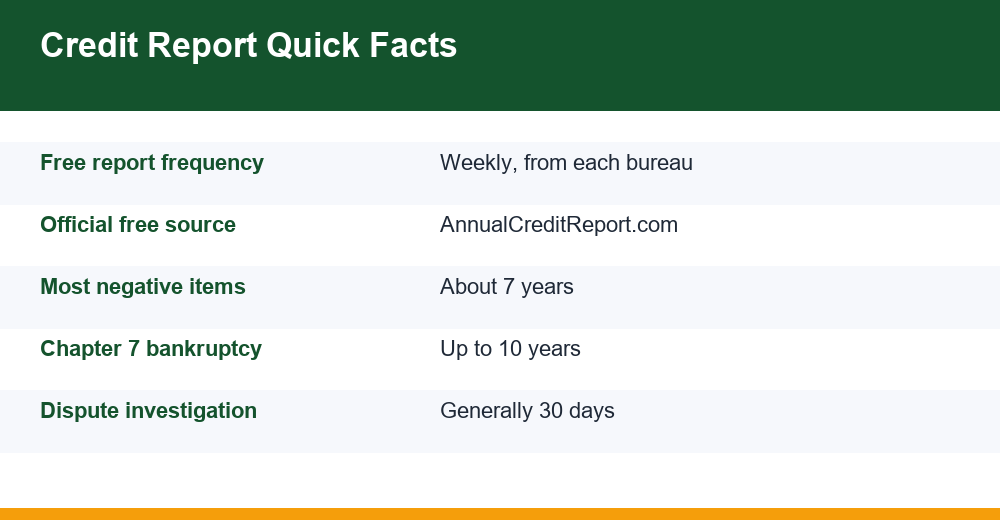
You can check your report from each of the three nationwide bureaus once a week, for free. The bureaus started weekly access during the pandemic in 2020 and made it permanent in 2023. That goes beyond the one free report per bureau every 12 months that federal law guarantees.
The only website authorized to deliver these federally backed free reports is AnnualCreditReport.com. You can also call 1-877-322-8228 or mail the official request form. Online requests are usually available right away; phone and mail requests are processed and mailed within 15 days.
Lookalike sites that ask for a card number for a “free trial” are not the official source. If a site wants payment details before showing your report, close the tab.
Other times you are entitled to a free report
- After a lender, insurer, landlord or employer takes adverse action based on your report (the notice names the bureau that supplied it)
- If you are a victim of identity theft or fraud and place a fraud alert
- If you are unemployed and plan to look for work within 60 days, or receive public assistance
Before you can use any credit report explained guide, you need the report itself. A sensible routine: pull all three reports together once or twice a year for a full review, spot-check one bureau every few months, and check weekly in the run-up to a big application such as a mortgage.
Credit report explained: the 7 sections in order
Each bureau uses its own design and labels, and the order shifts a little between the online view and a downloaded PDF. The content, though, falls into the same seven buckets. Here is each one, with what to look for.
1. Personal information
Your name and spelling variations, current and former addresses, date of birth, part of your Social Security number and sometimes employers. This data does not affect your score, but it is where mixed files and identity theft show up first. An address you never lived at is a red flag.
2. Summary or overview
A snapshot: number of open and closed accounts, total balances, total credit limits and counts of negative items. Use it to check totals against your own picture. Balances compared with limits on revolving accounts drive your credit utilization ratio, one of the most heavily weighted factors in common scoring models.
3. Account details (tradelines)
Usually the longest section. Each credit card, auto loan, student loan, mortgage or personal loan appears as its own block, called a tradeline. Typical fields include creditor name, partial account number, account type, date opened, credit limit or original loan amount, current balance, monthly payment, status and date of last activity.
Revolving accounts behave differently from installment loans here. If a card shows a high balance even though you pay in full every month, it helps to understand how credit cards work: issuers usually report the statement balance, not what you owe after paying it off.
4. Payment history grid
Inside each account, a month-by-month grid shows whether each payment was on time or 30, 60, 90, 120 or more days late. Lenders generally report a payment as late only once it is at least 30 days past due. A single wrong “30” in this grid can hurt more than anything else on the page.
5. Collections
Debts sold or assigned to a collection agency appear separately, sometimes alongside the original account. Check the collector’s name, the original creditor, the amount and the date of first delinquency. The same debt should not appear as two active balances owed.
Medical collections get special treatment. Under voluntary bureau policies, paid medical collections are removed, medical collections under $500 are not reported, and unpaid medical debt is not reported until a year after it goes to collections. A federal court vacated the CFPB’s separate rule banning medical debt from credit reports in July 2025, and several states have their own laws, so check your state’s rules if a medical item looks wrong.
6. Public records
Today this section mostly shows bankruptcies. Between 2017 and 2018 the three bureaus stopped including civil judgments and tax liens. If you see one, confirm it is yours and still within its reporting period.
7. Inquiries
A list of who has accessed your file and when, split into hard inquiries (from applications) and soft inquiries (account reviews, prescreened offers, your own checks). Only hard inquiries are visible to lenders. More on the difference below.
Many reports end with a consumer statement area and a summary of your rights under the Fair Credit Reporting Act. That is where any explanation you add after a dispute will appear.
How to read your credit report against your own records
Reading the report is not the same as checking it. The useful habit is to pair every important field with a document you control, then look for mismatches. Most guides that offer a credit report explained in general terms skip this step, yet it is where real errors get caught.
Gather your last few card and loan statements, any payoff or settlement letters, and the paperwork from accounts you closed. Then work through this table.
| Report field | Compare against | Typical error |
|---|---|---|
| Name, addresses, SSN digits | Your ID, lease or mortgage papers | Address you never lived at; another person’s data |
| Date opened | Account agreement or first statement | Wrong date shortens your credit history |
| Credit limit | Latest card statement | Limit missing or too low, raising utilization |
| Current balance | Most recent statement balance | Old balance on a paid-off account |
| Monthly payment status | Bank records of payments | Late mark for a month you paid on time |
| Account status | Closure or payoff letter | Closed account shown as open, or “closed by grantor” when you closed it |
| Collection amount and dates | Original bill and any settlement letter | Debt listed twice, or still owed after settlement |
| Hard inquiries | Your own list of applications | Inquiry from a lender you never applied with |
Work through one bureau fully before moving to the next. Lenders do not always report to all three, so an account missing from one report is not automatically an error.
Pay extra attention to the date of first delinquency on any negative item. It sets the clock for how long that item can legally be reported, and debts that change hands sometimes come back with a newer, incorrect date.
Hard vs soft inquiries: what is the difference?
A hard inquiry happens when you apply for new credit, such as a card, auto loan or mortgage, and the lender pulls your report to decide. Hard inquiries can lower your score slightly and stay visible for up to two years, though their effect on scores usually fades well before that.
A soft inquiry happens when you check your own report, when an existing creditor reviews your account, or when a company prescreens you for an offer. Soft inquiries do not affect your scores and are not shown to lenders.
| Situation | Inquiry type | Affects score? |
|---|---|---|
| You apply for a new credit card | Hard | Yes, usually a small, temporary dip |
| You check your own report | Soft | No |
| Your current card issuer reviews your account | Soft | No |
| You receive a prescreened offer in the mail | Soft | No |
| You accept that offer and formally apply | Hard | Yes |
| An employer screens you (with your written permission) | Soft | No |
Scoring models generally treat several mortgage, auto or student loan inquiries made within a short rate-shopping window as a single inquiry. The exact window depends on the model, so keep comparison shopping tight, ideally within a couple of weeks.
If you see a hard inquiry from a company you never applied with, treat it as a possible sign of identity theft and dispute it.
How long negative items stay on your report
Negative information does not stay forever. The Fair Credit Reporting Act sets limits, and for most items the clock starts from the original delinquency, not from when a debt was sold or last paid.
| Item | How long it can be reported |
|---|---|
| Late payments | About 7 years from the missed payment |
| Collection accounts | About 7 years from the original delinquency |
| Charged-off accounts | About 7 years from the original delinquency |
| Chapter 13 bankruptcy | Generally 7 years (bureau practice) |
| Chapter 7 bankruptcy | Up to 10 years |
| Hard inquiries | Up to 2 years |
| Accounts in good standing | Open ones stay; closed ones often about 10 years |
There are narrow exceptions. Older negative information may still be reported for a job paying $75,000 a year or more, a credit transaction of $150,000 or more, or life insurance with a face value of $150,000 or more.
Accurate negative items cannot be removed early just because you ask, and a company that promises to do it for a fee is a warning sign. The legitimate route is to dispute what is wrong, then let time and good habits do the rest.
A printable error-spotting checklist
Print this list or copy it into a note, then tick each item for all three bureaus. It turns the credit report explained above into a routine of roughly 30 minutes per bureau.
- Identity: name spellings, addresses, birth date and SSN digits are all yours.
- Unknown accounts: every tradeline is one you opened, co-signed or were added to as an authorized user.
- Duplicates: no single debt appears twice as an active balance.
- Balances: each balance roughly matches your most recent statement.
- Limits: every revolving account shows its correct credit limit.
- Payment grid: no late marks for months you paid on time.
- Status: paid, settled or closed accounts are labeled correctly.
- Collections: original creditor, amount and delinquency date are correct; medical items follow current bureau policies.
- Public records: any bankruptcy is yours and within its reporting period.
- Hard inquiries: each one matches an application you made.
- Old items: nothing negative is older than its reporting limit.
- Notes: for each error, write down the bureau, the account and the document that proves it.
If you find accounts you did not open, also consider a credit freeze with each bureau. Freezes are free under federal law and stop most new lenders from accessing your file until you lift them.
How to dispute an error on your credit report
Disputes are free, and you never need to pay anyone to file them. Dispute with each bureau that shows the error and, ideally, with the company that supplied the information, known as the furnisher.
- Pin down the error. Note the bureau, account name, partial account number and exactly which field is wrong.
- Collect proof. Send copies, never originals, of statements, payment confirmations, settlement letters or an identity theft report.
- File with the bureau. Use its online dispute center, phone line or a letter. By mail, use certified mail with return receipt requested so you can prove delivery.
- File with the furnisher. Write to the lender or collector at the dispute address it provides, explain the error and enclose copies of your proof.
- Track the clock. Bureaus generally must investigate within 30 days. That can stretch to 45 days if you dispute after receiving your free annual report or send new information during the investigation.
- Read the results. The bureau must send you the outcome within five business days of finishing. If the item is corrected, check your other two reports too.
- Escalate if needed. If the result is wrong, you can add a brief statement to your file, re-dispute with new evidence, or submit a complaint to the Consumer Financial Protection Bureau.
The CFPB’s guide on how to dispute an error on your credit report walks through the process for both the bureau and the furnisher.
Keep a simple log: date filed, method, confirmation number and outcome. If the same error reappears months later, that log is the fastest way to show it was already corrected.
What to do after your review
With your credit report explained and checked line by line, you are left with two lists: errors to dispute and accurate items to manage. The second list is where your habits matter most.
- Automate payments for at least the minimum on every account, since payment history carries the most weight in common scoring models.
- Watch revolving balances before statement dates, because that is usually the figure that gets reported.
- Keep older accounts open when they cost nothing, to protect the length of your history.
- Space out applications so hard inquiries do not cluster.
- Recheck in a few months to confirm disputed items stayed fixed.
For a fuller plan built on what you just found, see our guide on how to improve your credit score. A clean, accurate report will not raise your score overnight, but it makes sure every point you earn actually counts.
This article is educational and is not financial or legal advice. Rules can change, so confirm current details with the bureaus or official federal sources before acting.
Frequently Asked Questions
Is a credit report the same as a credit score?
No. Your credit report is the detailed record of your accounts, payments, collections, public records and inquiries. A credit score is a number a scoring model calculates from that record. Different models can produce different scores from the same report, and the free reports from the three bureaus usually do not include a score at all.
How often can I get a free credit report?
You can get a free report from each of the three nationwide bureaus, Equifax, Experian and TransUnion, once a week through AnnualCreditReport.com. Weekly access became permanent in 2023. You can also order by phone at 1-877-322-8228 or by mail, though those reports are processed and mailed within 15 days.
How long do negative items stay on a credit report?
Most negative items, including late payments, collections and charge-offs, can be reported for about seven years from the original delinquency. Chapter 13 bankruptcy generally stays seven years and Chapter 7 up to ten years. Hard inquiries remain for up to two years. Accurate items cannot be removed early, but errors can be disputed for free.
What is the difference between a hard and soft inquiry?
A hard inquiry occurs when you apply for new credit and a lender reviews your report to decide. It can lower your score slightly and stays visible for up to two years. A soft inquiry happens when you check your own report, an existing creditor reviews your account, or you are prescreened. Soft inquiries never affect your scores.