
Understanding how to improve credit score results comes down to a handful of steady habits, not luck, gimmicks, or secret tricks. Your score is simply a snapshot of how you have handled borrowed money, which means you have more control over it than you might think. This guide walks through what shapes the number and the practical, safe steps that move it in the right direction over time.
Table of Contents
What Actually Shapes Your Credit Score
Before you can raise a number, it helps to know what feeds it. The most common scoring models, like FICO and VantageScore, look at the same broad ingredients from your credit reports. They do not consider your income, your job title, your age, or your background, only how you have managed credit.
The rough weightings below are illustrative and vary between scoring models, but they show where your energy is best spent. Payment history and how much of your available credit you use together account for the largest share of most scores.
- Payment history (about 35%): whether you pay on time, every time.
- Amounts owed / utilization (about 30%): how much of your available credit you are using.
- Length of credit history (about 15%): how long your accounts have been open.
- Credit mix (about 10%): the variety of accounts, such as cards and loans.
- New credit (about 10%): how often you apply for and open new accounts.
Notice that two factors alone account for the majority of your score. If you only ever focus on paying on time and keeping balances low, you are already doing the two things that matter most. If you are still learning the mechanics of cards, our guide on how credit cards work is a helpful companion read.
Because payment history carries the most weight, a steady record of on-time payments is the foundation everything else sits on. Even if other parts of your profile are thin, a long stretch of paying as agreed sends the clearest possible signal that you can be trusted with credit.
It also helps to see your score as a range rather than a single magic number. Most models run from roughly 300 to 850, and lenders group borrowers into broad tiers. Aiming to move from one tier to the next, rather than chasing an exact figure, is usually the more useful way to think about how to improve credit score over the long run.
For a plain, no-sales-pitch explanation straight from a regulator, the Consumer Financial Protection Bureau keeps a clear overview of what goes into a good score.
How to Improve Credit Score: 11 Smart Moves
Here is the practical heart of the guide. None of these moves are quick tricks; they are simply the habits that scoring models reward. You do not have to do all eleven at once. Pick the one or two that fit your situation and build from there.
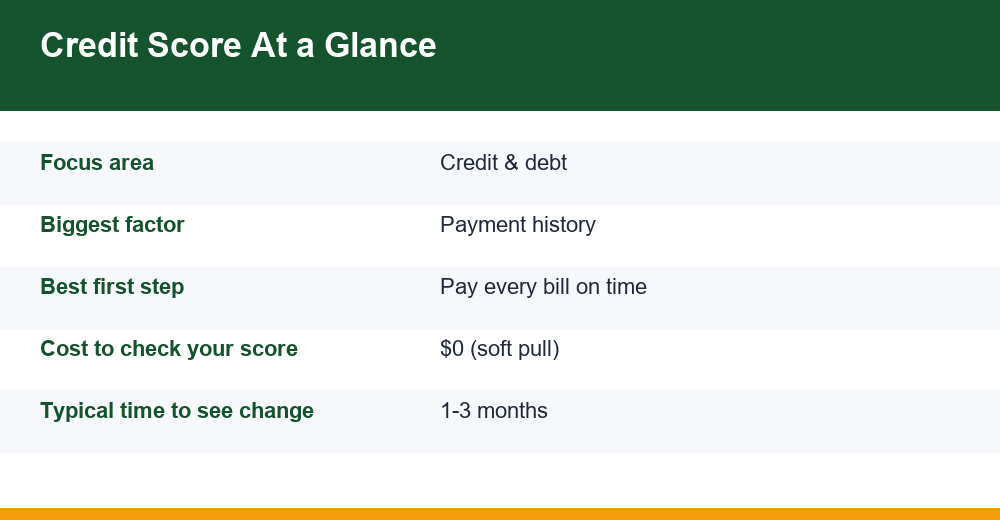
- Pay every bill on time. This is the single biggest lever. Even one missed payment can linger on your report, so automate at least the minimum on every account.
- Lower your credit utilization. Try to keep balances well below your limits. Using a smaller slice of your available credit generally helps.
- Pay down balances before the statement closes, since the balance reported to the bureaus is often the one on your statement date, not your due date.
- Ask for a credit limit increase on a card you already handle well. A higher limit with the same spending lowers your utilization.
- Do not close your oldest credit card. Keeping it open preserves your length of history and your total available credit.
- Check your credit reports for errors and dispute anything that is wrong, such as a payment marked late that you actually made on time.
- Space out new applications so you are not collecting several hard inquiries in a short window.
- Keep older accounts active with a small recurring charge so they are not closed for inactivity.
- If you carry balances across several cards, build a clear payoff plan instead of paying randomly.
- Set up alerts for due dates and balances so nothing is forgotten.
- Be patient and consistent. Positive history builds up quietly, month after month.
If you are not sure where to begin, start at the top of this list and work down. The earlier steps tend to carry the most weight, so nailing on-time payments and lower balances first gives you the best return for the least effort.
A quick word on credit utilization, since it trips up so many people. It simply means the share of your available credit you are currently using. If you had a $1,000 limit and a $300 balance, your utilization on that card would be thirty percent. Lower is generally viewed more favorably, and the figures here are illustrative examples rather than fixed rules that apply to everyone.
If several of those steps feel out of reach because debt is the real obstacle, that is worth tackling head-on. Our walkthrough on how to pay off debt pairs naturally with these moves, because a lower balance usually means a healthier score.
The short version of how to improve credit score progress is this: pay on time, owe less, and avoid unnecessary risk signals. Everything else is a refinement of those three ideas.
Quick Wins vs. Slow, Steady Gains
Some changes can nudge your score within a billing cycle or two, while others reward patience. Knowing the difference keeps you from feeling discouraged when the number does not jump right away.
Faster-moving levers include lowering your utilization and correcting a genuine reporting error. Slower-moving levers include building length of history and letting an old late payment age into the past.
- Quicker: paying a card down before the statement closes.
- Quicker: disputing and removing an inaccurate mark.
- Slower: growing the average age of your accounts.
- Slower: recovering from a missed payment or collection.
- Slower: proving a steady, on-time track record over years.
It also helps to remember that scores can move slightly from month to month even when you do everything right, simply because balances and reporting dates shift. A small dip is rarely a sign that something is wrong, so try not to react to every point of movement.
If you are working through several balances and want a method that keeps you motivated, the debt snowball method focuses on clearing your smallest balances first, which can free up utilization and give you early momentum.
How to Build Credit From Scratch
If you have little or no credit history, you are not stuck, you simply have a blank page. The goal is to create a small, positive track record that scoring models can actually see.
A few common starting points, each with its own trade-offs, can help you begin responsibly. Choose one you can manage comfortably rather than opening several at once.
- A secured credit card, where a refundable deposit backs a small limit you use lightly and pay off in full.
- Becoming an authorized user on a trusted family member’s well-managed card, so their good history can support yours.
- A credit-builder account designed specifically to establish a payment record.
- A small installment loan you can realistically repay on schedule.
It is also worth checking whether your rent or certain utility payments can be reported to the bureaus through an approved service, since some models can factor them in. Availability varies widely, so treat it as a possible bonus rather than a guaranteed shortcut.
When you compare starter products, read the fine print for fees rather than chasing rewards. A simple, low-cost account you understand fully is far more useful for building history than a flashy one you might mismanage. Whatever you choose, the winning behavior is identical to everything above: small charges, paid on time, kept well within the limit. Give it several months and your file starts to reflect the responsible borrower you are becoming.
How Long Does It Take to See Results?
There is no universal timeline, because your starting point, your history, and which lever you pull all matter. Part of learning how to improve credit score is setting realistic expectations about time. The table below offers a general, illustrative sense of how different actions tend to play out. These are examples, not guarantees for any individual.
| Action you take | Typical time to show up | Why |
|---|---|---|
| Pay a card balance down | 1-2 billing cycles | New lower balance is reported to bureaus |
| Fix a reporting error | About 30-45 days | Bureaus investigate and update the file |
| Add on-time payments | A few months | History builds gradually |
| Recover from a missed payment | Many months | Negative marks fade slowly over time |
| Build a brand-new file | About 3-6 months | A score needs some activity to generate |
The pattern is clear: balance and accuracy changes tend to surface quickly, while trust is rebuilt slowly. Treat the number as a long-term project and the short-term dips will bother you far less. If a change you expected does not show up right away, give the reporting cycle time to catch up before assuming something went wrong.
Credit Score Myths You Can Safely Ignore
A lot of credit advice passed around at dinner tables is simply wrong, and some of it can actively hold you back. Here are the ones worth clearing up.
Checking your own score hurts it
It does not. Viewing your own report is a soft inquiry and has no effect on your score. Only a hard inquiry, triggered when you apply for new credit, has a small, temporary impact.
You must carry a balance to build credit
Also false. You can pay your statement in full every month and still build an excellent history. Carrying a balance mainly earns you interest charges, not extra points.
Closing old cards helps your score
Usually the opposite. Closing an old account can shorten your history and shrink your available credit, which can nudge your utilization higher. When in doubt, keep old accounts open and lightly used.
Paying off a collection instantly erases it
Not always. Depending on the scoring model and how your lender reports, a paid collection can still appear on your report for some time, though its impact generally softens once the balance shows as settled. Paying it is still worthwhile, both for your record and your peace of mind.
One more: your income, age, and background are not part of the scoring formula. Two people with very different salaries can hold the very same score.
Habits That Keep Your Score Strong
Improving your score is one thing; protecting it is another. Once you have made progress, a few light-touch routines keep the number steady without much effort. Building the score is only half of how to improve credit score results that actually last.
- Review your credit reports a few times a year and dispute anything inaccurate.
- Keep utilization low as a permanent habit, not just before a loan application.
- Let good accounts age quietly rather than churning through new ones.
- Automate payments so a busy month never becomes a missed payment.
- Only borrow for things that genuinely fit your plan.
Guarding against identity theft belongs in this routine too. Reviewing your reports regularly is the simplest way to spot an account you did not open, and catching a problem early keeps it from quietly dragging your score down for months.
Think of your credit score as a reflection of consistent, everyday choices rather than a test you study for at the last minute. Small, repeated actions almost always beat dramatic one-off efforts, and they are far easier to sustain once they become routine.
Finally, a gentle reminder: this article is general educational information, not personalized financial, tax, or legal advice. Everyone’s situation is different, so for decisions that carry real weight it is wise to consider your own circumstances and speak with a licensed or qualified professional you trust.
Frequently Asked Questions
Does checking my own credit score lower it?
No. Looking at your own score or report counts as a soft inquiry, which has zero impact on your number and is not visible to lenders. Only hard inquiries, made when you apply for new credit, can cause a small, temporary dip.
What is the fastest way to improve a credit score?
The quickest levers are usually lowering your credit utilization and correcting genuine errors on your report. Paying a card down before the statement closes can show up within a billing cycle or two, though results vary from person to person.
Will paying off debt improve my credit score?
Often, yes. Lowering your balances reduces your utilization, which is a major scoring factor, and demonstrates reliable repayment. The exact effect depends on your overall profile, but reducing what you owe is one of the most dependable long-term moves.
How long does it take to rebuild credit after a missed payment?
There is no fixed timeline. A single late payment can affect your score for a while, but its weight fades as you add on-time payments. With steady, consistent habits, many people see meaningful improvement over several months to a couple of years.