
Your credit utilization ratio is the share of your available revolving credit that you are using, and it is one of the few credit score inputs you can change within a single billing cycle. This guide shows how the number is calculated overall and per card, why the statement closing date matters more than the due date, and six practical ways to bring it down without hurting the rest of your credit profile.
Table of Contents
What Is a Credit Utilization Ratio?
Utilization compares what you owe on revolving accounts, mainly credit cards and revolving lines of credit, with the total credit limits on those same accounts. Installment debt such as a car loan, student loan or mortgage is tracked separately and does not feed into this particular calculation.
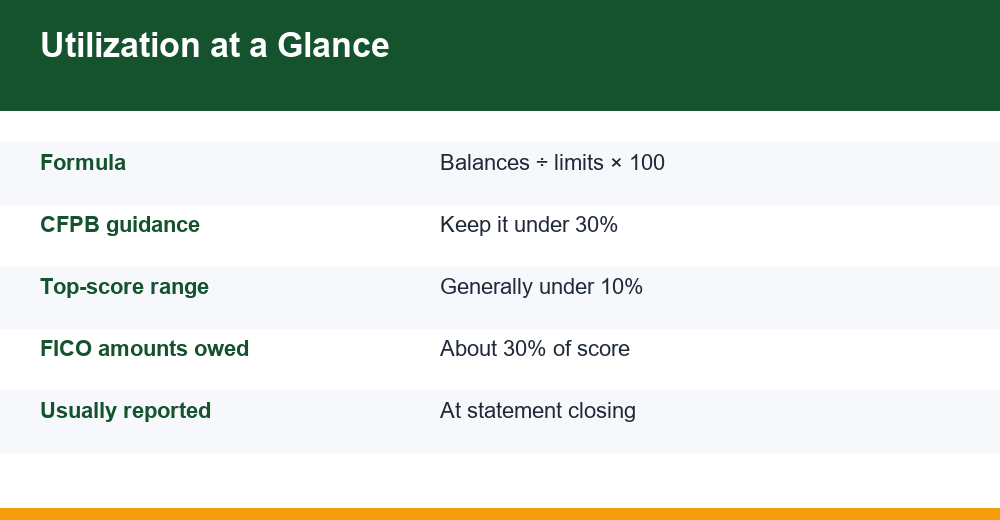
The formula is simple: total revolving balances ÷ total credit limits × 100. If you owe $1,500 across cards with combined limits of $10,000, you are using 15% of the credit available to you.
Why lenders care: a person who is close to maxing out their cards is statistically more likely to fall behind on payments. FICO groups utilization under its “amounts owed” category, which it says accounts for about 30% of a typical FICO Score, second only to payment history at about 35%. As a general pattern, the higher your utilization climbs, the more pressure it puts on your scores.
The balances used in the math are whatever your card issuers report to Equifax, Experian and TransUnion, which most issuers do about once a month. Each account entry on your report lists the reported balance and the credit limit, and our guide to reading your credit report line by line shows exactly where to find both.
- Usually included: general-purpose credit cards, store cards and revolving personal lines of credit.
- Not included: auto loans, student loans, mortgages and fixed-payment personal loans.
- Handled differently: charge cards without a preset spending limit, and some home equity lines, depending on the scoring model.
Is Utilization Calculated Per Card or Overall?
Both. Scoring models look at your overall utilization across every revolving account and at the ratio on each individual card. A single card running close to its limit can weigh on your score even when your overall credit utilization ratio looks healthy.
A worked example with three cards
| Card | Credit limit | Reported balance | Per-card utilization |
|---|---|---|---|
| Card A | $2,000 | $1,800 | 90% |
| Card B | $5,000 | $200 | 4% |
| Card C | $8,000 | $0 | 0% |
| All cards | $15,000 | $2,000 | 13.3% overall |
At 13.3%, the overall number looks fine. Card A, though, is almost maxed out, and that single account can still signal stress to a scoring model.
Suppose you have $1,000 available to pay down debt. Sending all of it to Card A drops that card to 40% and your overall figure to about 6.7%. Splitting it evenly across the two cards with balances would lower the overall number by the same amount, but Card A would sit around 65%, which looks worse on a card-by-card basis.
One caveat: if you carry balances from month to month, the card with the highest interest rate is usually the cheapest one to attack first. When the goal is a score boost before a loan application, target the highest per-card ratio; when the goal is saving money over time, interest rate usually wins.
FICO also counts how many of your accounts are carrying balances as part of the amounts-owed picture, so having fewer cards with reported balances can help a little on its own.
What Is a Good Credit Utilization Ratio?
The Consumer Financial Protection Bureau’s guidance on getting and keeping a good credit score suggests keeping utilization below 30%. Experian has noted that people with the highest scores tend to keep revolving utilization in the single digits. Put those together and the practical message is clear: 30% is a ceiling, not a target.
There is no published cliff where your score jumps the moment you cross from 31% to 29%. Scores generally improve gradually as utilization falls, which is why many credit experts suggest aiming for single digits when you can.
| Overall utilization | How it is generally viewed | Practical takeaway |
|---|---|---|
| 0% | No revolving balances reported | Fine; no extra benefit over a low figure |
| 1% to 9% | Typical of top scores | A strong place to stay |
| 10% to 29% | Generally acceptable | Room to improve before a big application |
| 30% to 49% | Above common guidance | Make paydown a priority |
| 50% and up | Signals heavy reliance on credit | Likely pulling your score down |
These bands are approximate general guidance. FICO and VantageScore do not publish exact thresholds, and the effect of a given ratio depends on the rest of your file.
Is 0% credit utilization bad?
No, but it is not a secret upgrade either. A 0% figure offers no meaningful advantage over a low ratio. Some credit experts have observed that reporting a small balance on one card can score marginally better than reporting zero everywhere, but the difference is minor.
A bigger risk of never using a card is that the issuer may eventually close it for inactivity, which shrinks your available credit. A small recurring charge, such as a streaming subscription, paid off in full each month keeps the account active at no cost.
Utilization is only one lever. For the full picture, including payment history and credit age, see our step-by-step plan to improve your credit score.
Does Paying Before the Statement Date Lower Utilization?
Usually, yes. Most issuers report your balance to the credit bureaus as of the statement closing date, not the payment due date. Paying in full by the due date avoids interest, but the balance that reached the bureaus may still be the full statement amount.
This is the most common misunderstanding about the credit utilization ratio. Many people pay in full every month and assume their reported utilization is zero, when in fact their report shows every statement balance in full.
How the timing plays out
- Your billing cycle starts on March 1 on a card with a $3,000 limit, and you charge $1,200 during the month.
- Scenario 1: the statement closes on March 28 showing $1,200. That balance, 40% of the limit, is what gets reported. You pay in full by the April 22 due date and owe no interest, but the 40% figure is already on your report.
- Scenario 2: you pay $1,100 on March 25, three days before the statement closes. The statement shows $100, and the reported utilization is about 3.3%. You still pay the remaining $100 by the due date.
Both scenarios cost you nothing in interest. Only the second one improves the number lenders see.
- Find each card’s closing date on your statement or in the issuer’s app; it is often different for every card.
- Set a reminder two or three days before it, since payments can take a business day or two to post.
- A few issuers report at other points in the month. If your report does not reflect the lower balance, ask the issuer when it sends data.
6 Smart Ways to Lower Your Credit Utilization Ratio
The methods below range from immediate and free to slower moves with trade-offs. Most people get the biggest results from the first three.
1. Pay down the most stretched card first
As the worked example showed, a payment aimed at the card with the highest per-card ratio improves both your overall and individual figures. If you are juggling several balances, a structured debt payoff method such as avalanche or snowball keeps you consistent month after month.
2. Pay before the statement closes
This is the quickest fix for anyone who already pays in full. Move your main payment a few days ahead of the closing date so a small balance is reported instead of your whole month of spending.
3. Make more than one payment a month
Paying weekly or after large purchases keeps the running balance low all month. It also helps if you use one card for most spending and its limit is modest, because the balance never builds up far enough to look heavy.
4. Ask for a credit limit increase, carefully
A higher limit lowers your ratio with no change in spending. Some issuers grant increases automatically or with a soft inquiry, while others run a hard inquiry, which can lower your score slightly for a time. Ask the issuer which applies before you request one, and only do this if you trust yourself not to spend into the new room.
5. Keep old, no-fee cards open and lightly used
An unused card with no annual fee still adds to your total available credit. Keeping it active with a small charge protects that limit and the length of your credit history.
6. Spread or restructure balances with care
If one low-limit card carries most of your spending, shift routine purchases to a card with a larger limit. Some people consolidate card debt into a fixed-rate installment loan, which moves the balance out of the revolving category. That can lower utilization, but it means a new account and a hard inquiry, and it only helps if the cards are not run up again.
| Method | Speed | Cost or risk |
|---|---|---|
| Pay down highest-ratio card | Next statement | Uses cash you may need elsewhere |
| Pay before statement closes | Next statement | None if you track dates |
| Multiple payments a month | Next statement | Requires attention |
| Credit limit increase | Varies by issuer | Possible hard inquiry |
| Keep old cards active | Ongoing | Small charge to manage |
| Consolidation loan | After new account reports | Hard inquiry, new account |
Does Closing a Credit Card Hurt Utilization?
It can. Closing a card removes its limit from your total available credit, so the same balances now represent a larger share. If you carry balances on other cards, closing an account can push your utilization up and your score down.
Go back to the three-card example. If you close Card C, the unused card with an $8,000 limit, your total limit drops to $7,000. The same $2,000 in balances now works out to about 28.6% instead of 13.3%, without a dollar of new spending.
| Move | Effect on available credit | Possible upside | Possible downside |
|---|---|---|---|
| Close a card with an annual fee | Decreases | Stop paying the fee | Higher ratio |
| Close a no-fee card you rarely use | Decreases | One less account to monitor | Higher ratio, little benefit |
| Request a limit increase | Increases | Lower ratio right away | Possible hard inquiry |
| Open a new card | Increases | More available credit | Hard inquiry, younger average account age |
There are still good reasons to close a card: an annual fee you no longer get value from, or a card that tempts you to overspend. Before closing, ask the issuer whether you can switch to a no-fee version of the same account. If you do close it, pay down other balances first so the jump in utilization is smaller.
A closed account in good standing does not disappear from your report immediately; its payment history typically remains for years. What changes at once is the available credit used in the utilization math.
How Quickly Does Lowering Utilization Raise Your Score?
Often faster than any other credit improvement. In many widely used score versions, utilization is read as a snapshot of what your report shows when the score is calculated, so once a lower balance is reported, a newly pulled score reflects it.
In practice the bottleneck is reporting. Most issuers send data after each statement closes, and the bureaus take a few days to process it. A realistic window is roughly one to two billing cycles from your payment to an updated score, though this is approximate and varies by issuer.
- Same month: pay before the closing date, and the lower balance can appear on your report within days of the statement.
- After a payment past the closing date: expect to wait for the next statement cycle.
- Applying for a mortgage: lenders can sometimes request a rapid rescore through the bureaus after you pay down balances; ask your loan officer whether it is available.
One caution: newer models such as FICO Score 10 T and VantageScore 4.0 can use trended data, which looks at how your balances move over time rather than a single month. Under those models, a habit of keeping your credit utilization ratio low counts for more than a one-time paydown just before applying.
A Simple Monthly Routine to Keep It Low
Keeping your credit utilization ratio low is mostly about habits rather than tricks. A ten-minute monthly check is enough for most households.
- List each card’s statement closing date and due date in one place.
- Three days before each closing date, check the balance and pay it down to a small amount.
- Pay any remaining statement balance in full by the due date to avoid interest.
- Once a month, total your balances and limits to see your overall and per-card figures.
- Check your credit reports regularly to confirm balances and limits are reported correctly, and dispute any limit shown lower than it should be.
An incorrectly reported limit, or a card showing no limit at all, can make your utilization look higher than it really is. Catching those errors is one of the simplest ways to protect your score.
This article is educational and is not personalized financial advice. If you are dealing with debt you cannot manage, a nonprofit credit counselor can help you build a plan.
Frequently Asked Questions
What is a good credit utilization ratio?
The CFPB suggests keeping utilization below 30%, but treat that as a ceiling rather than a goal. People with the highest credit scores tend to stay in the single digits. Aim for under 10% overall and avoid letting any single card climb close to its limit, since per-card ratios also count.
Is credit utilization calculated per card or overall?
Both. Scoring models look at your combined balances divided by your combined limits, and at the ratio on each individual card. A card that is nearly maxed out can hurt your score even when your overall figure is low, so paying down the most stretched card first usually gives the biggest improvement.
Is 0% credit utilization bad?
It is not bad, but it offers no real advantage over a low ratio. Some experts have seen slightly better results when one card reports a small balance, though the difference is minor. The bigger risk is inactivity: an issuer may close a card you never use, reducing your available credit and raising future utilization.
How quickly does lowering utilization raise my score?
Usually within about one to two billing cycles. Most issuers report balances after each statement closes, and the bureaus need a few days to update. Many score versions read utilization as a current snapshot, so once the lower balance appears on your report, a newly calculated score should reflect it.