The money market account vs savings question sounds simple, but most people are actually juggling three products: a money market account, a high-yield savings account and a money market fund. Two of them are insured bank deposits and one is an investment, and that single distinction matters more than any rate difference. Here is how they really compare, and which one fits an emergency fund or a short-term goal.
Table of Contents
Money market account vs savings: the short answer
A money market account (often called a money market deposit account, or MMDA) is a type of savings deposit offered by banks and credit unions. It pays interest like a savings account but usually adds some checking-style features, such as a debit card or the ability to write a limited number of checks.
A regular savings account is simpler: you deposit money, it earns interest, and you move it out by transfer or at a branch. A high-yield savings account is the same product with a more competitive rate, usually from an online bank or the online arm of a larger bank.
So when people weigh money market account vs savings, they are comparing two close cousins. Both are bank deposits, both are normally insured, and both are built for cash you want safe and reachable. The real differences are about access, minimums and how the interest is structured.
- Pick a savings account if you want the lowest minimums and the simplest setup.
- Pick a money market account if you want to pay a few large bills directly from your savings and can comfortably meet the minimum balance.
- Be careful with money market funds: they live at a brokerage, are investments, and are not FDIC insured.
5 honest differences between the two accounts
What is the difference between a money market account and a savings account in practice? Banks market them differently, but the gaps come down to five things. None of them is about safety, because both sit under the same deposit insurance rules.
1. Access to your money
Money market accounts often come with check writing or a debit card. Savings accounts usually do not. That makes a money market account handy for paying a large, irregular bill, like an insurance premium, a property tax installment or a contractor invoice, straight from savings.
2. Minimum balances
Money market accounts are more likely to require a minimum opening deposit or a minimum daily balance to avoid a monthly fee or to earn the advertised rate. Many online savings accounts have no minimum at all, which makes them easier to start with a small amount.
3. Interest structure
Money market accounts frequently use tiered rates, paying more as your balance grows. Savings accounts more often pay one rate on every dollar. Neither type is automatically higher: a good online high-yield savings account can beat a branch bank’s money market account, and the reverse also happens. Both rates are variable and can change at any time.
4. Withdrawal limits
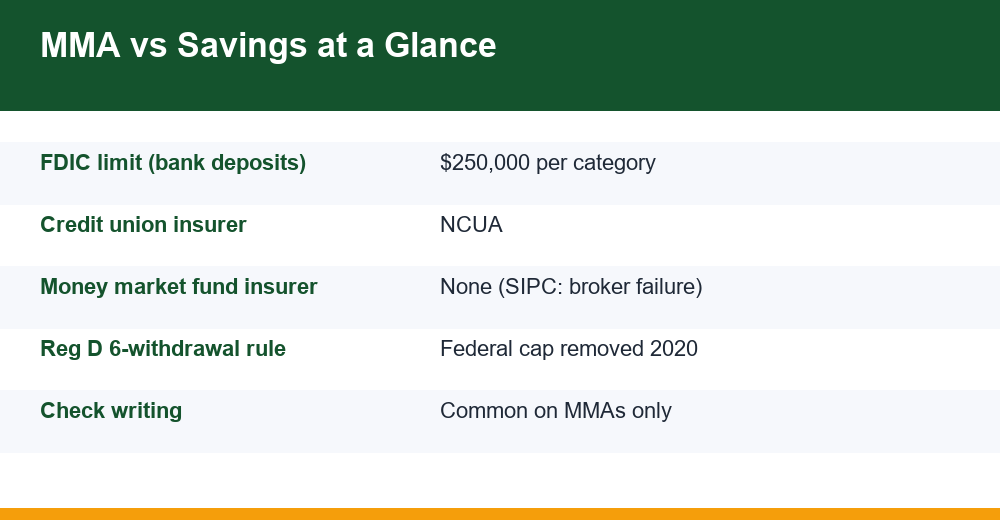
Federal Regulation D used to cap certain convenient withdrawals and transfers from savings and money market accounts at six per month. The Federal Reserve removed that requirement in April 2020, but banks are still allowed to set their own limits, and many do. Check the account terms for any excess-withdrawal fee or a rule that converts the account after repeated overages.
5. Fees
Because money market accounts behave a bit like checking, they are more likely to carry a monthly maintenance fee if your balance dips below the minimum. A fee of even a few dollars a month can wipe out the interest on a small balance, so read the fee schedule before comparing rates.
| Feature | Savings / high-yield savings | Money market account |
|---|---|---|
| Where it is held | Bank or credit union | Bank or credit union |
| Deposit insurance | FDIC or NCUA, up to $250,000 per category | FDIC or NCUA, up to $250,000 per category |
| Check writing | Rarely | Often |
| Debit card | Rarely | Sometimes |
| Minimum balance | Often none online | More common |
| Interest | Usually one rate | Often tiered by balance |
| Withdrawal limits | Set by the bank | Set by the bank |
| Monthly fee risk | Low at online banks | Higher if below minimum |
Is a money market account FDIC insured?
Yes, when it is held at an FDIC-insured bank. A money market deposit account is a deposit, so it is covered by the FDIC up to $250,000 per depositor, per insured bank, for each account ownership category. Savings accounts get exactly the same treatment, as the FDIC explains in its guide to understanding deposit insurance.
At a federally insured credit union, the equivalent coverage comes from the NCUA through the National Credit Union Share Insurance Fund, with the same standard $250,000 limit. Credit unions sometimes call the product a money market share account, but it works the same way.
A few details trip people up:
- The limit applies per bank, not per account. A savings account and a money market account at the same bank, both in your name alone, share one $250,000 limit.
- Ownership categories matter. Individual, joint and certain retirement accounts are counted separately, which can raise your total coverage at one bank.
- Fintech apps are not always banks. If an app holds your money through a partner bank, confirm which bank it is and how your funds are titled.
- The words “money market” in a product name do not prove insurance. Look for the words “deposit account” and the FDIC or NCUA name.
If you hold more than the insured limit, spreading money across more than one bank, or using different ownership categories, is the simplest fix.
Money market account or money market fund? Not the same thing
Is a money market account the same as a money market fund? No, and this is the most expensive mix-up in personal finance vocabulary. A money market fund is a type of mutual fund. You buy shares through a brokerage or fund company, and the fund invests in short-term debt like Treasury bills, repurchase agreements and commercial paper.
Because it is an investment and not a bank deposit, a money market fund is not FDIC insured, even if you buy it through a bank or it carries a bank’s name. Fund documents are required to warn that you could lose money, and the sponsor has no legal obligation to support the fund.
What about SIPC? Brokerage accounts are usually protected by the Securities Investor Protection Corporation, up to $500,000 per customer, including a $250,000 limit for cash. But SIPC only steps in if the brokerage firm fails and customer assets are missing. It does not cover a drop in the value of what you own.
| Money market account | Money market fund | |
|---|---|---|
| Product type | Bank deposit | Mutual fund (investment) |
| Where you get it | Bank or credit union | Brokerage or fund company |
| Protection | FDIC / NCUA up to $250,000 | No FDIC; SIPC only if broker fails |
| Price | Balance does not fall from market moves | Aims for a stable $1.00 share price, not guaranteed |
| Yield | Set by the bank | Moves with short-term market rates |
| Getting cash out | Transfer, check or debit card | Sell shares, then move cash |
Money market funds are still widely used for cash at brokerages, and government money market funds hold mostly cash, Treasury and agency debt. They can be a reasonable place to park cash you plan to invest soon. Just do not treat one as an insured savings account.
Can you lose money in a money market account?
In a money market account at an insured bank, your principal is protected up to the insurance limit. Your balance will not fall because interest rates or markets move. Losses in practice come from other places:
- Fees: a monthly maintenance fee or excess-withdrawal fee can exceed the interest you earn on a small balance.
- Inflation: if your rate is below inflation, your money buys less over time even though the dollar amount grows.
- Balances above the limit: money above $250,000 per ownership category at one bank is not covered if the bank fails.
- Rate cuts: rates are variable, so your yield can drop whenever the bank decides to lower it.
A money market fund is different. Its share price is designed to stay at $1.00, but that is a goal, not a promise. It is rare for a fund to “break the buck”, yet it has happened, most famously when the Reserve Primary Fund fell below $1.00 in September 2008.
After that episode, the SEC tightened the rules several times. Its 2023 reforms raised minimum liquidity requirements, removed funds’ ability to temporarily suspend redemptions with gates, and require institutional prime and institutional tax-exempt funds to charge a liquidity fee when daily net redemptions exceed 5% of net assets. Retail investors are more likely to meet discretionary fees, which a fund board can impose on non-government funds, capped at 2% of the amount redeemed.
Government money market funds are exempt from the mandatory liquidity fee, which is one reason many brokerages use them as the default cash sweep option.
Emergency fund: money market or high-yield savings?
Which is better for an emergency fund: money market or high-yield savings? For most households, an insured high-yield savings account or a money market account both work well. The right choice depends on how you would actually pay for an emergency.
If you would simply move money to checking and pay from there, a high-yield savings account is usually the simplest pick: no minimums, competitive rates, and less temptation to spend from it. If you would rather write a check or swipe a card directly from your emergency stash, a money market account adds that convenience.
A money market fund can hold emergency cash for people who already keep most of their money at a brokerage, but remember it is not insured and selling shares adds a step before the cash lands in your bank. Allow at least one or two business days for that transfer.
| Your situation | Best fit | Why |
|---|---|---|
| Building your first emergency fund | High-yield savings | No minimums, insured, easy to set up |
| Balance well above the bank’s minimum | Money market account | Tiered rates and direct check or card access |
| You often pay big bills by check | Money market account | Pay straight from savings |
| You spend money you can see in checking | High-yield savings at a separate bank | Distance reduces impulse spending |
| Cash already sits at a brokerage | Money market fund (with care) | Convenient, but not FDIC insured |
| More than $250,000 in cash | Split across banks | Stay within insurance limits |
Whichever account you choose, the habit matters more than the product. Our guide on how to build an emergency fund walks through target amounts and automatic transfers.
Money market account vs savings for short-term goals
For goals one to three years out, such as a car down payment, a wedding or a home repair, the money market account vs savings decision usually comes down to balance size and how you plan to spend the money when the time comes.
- Small or growing balance: a high-yield savings account avoids minimums and fees while the balance builds.
- Large balance you will pay out in chunks: a money market account’s check access and tiered rate can make sense.
- A firm date you will not touch the money before: consider certificates of deposit, which can lock in a rate for a fixed term.
- Several goals on different timelines: open separate accounts or sub-accounts so each goal has a clear balance.
If you have a known date and want to protect yourself from future rate cuts, a CD ladder strategy spreads money across certificates that mature at different times, so some cash frees up regularly. The trade-off is an early withdrawal penalty if you need the money sooner.
One honest note: the rate gap between a good money market account and a good savings account is often small. Shopping across banks tends to matter more than which of the two account types you choose.
A quick checklist before you open either one
Once you have settled the money market account vs savings question for your situation, run through these points before you move any money. They take ten minutes and prevent most surprises.
- Confirm the institution is FDIC insured (banks) or NCUA insured (credit unions), and that the product is a deposit account.
- Read the fee schedule: monthly fees, minimum daily balance, excess-withdrawal fees.
- Check whether the advertised rate is promotional or applies only to a certain balance tier.
- Find out how fast transfers reach your checking account, especially for an emergency fund.
- Note any monthly limit the bank sets on withdrawals or transfers.
- If the account is offered through an app, identify the partner bank holding the money.
- Remember that interest is taxable income; banks generally send a Form 1099-INT when you earn $10 or more in a year, and smaller amounts are still taxable.
This article is educational and not personalized financial advice. Rates and account terms change often, so always compare current offers and read the account disclosures before you open anything.
Frequently Asked Questions
What is the difference between a money market account and a savings account?
Both are insured bank deposits that earn interest. A money market account usually adds checking-style features such as check writing or a debit card, often uses tiered rates, and is more likely to require a minimum balance. A savings account is simpler, frequently has no minimum, and is usually accessed by transfer rather than by check or card.
Is a money market account FDIC insured?
Yes, when it is opened at an FDIC-insured bank. Coverage is up to $250,000 per depositor, per bank, for each ownership category, the same as a savings account. At a federally insured credit union the NCUA provides equivalent coverage. Money market funds held at a brokerage are a different product and are not FDIC insured.
Is a money market account the same as a money market fund?
No. A money market account is a bank deposit with deposit insurance. A money market fund is a mutual fund sold through brokerages that invests in short-term debt. It aims to keep a stable $1.00 share price but is not guaranteed or FDIC insured, and SIPC only covers brokerage failure, not investment losses.
Can you lose money in a money market account?
Your principal is protected up to the insurance limit at an insured bank or credit union, so market swings will not reduce your balance. You can still lose value through monthly fees, excess-withdrawal charges, inflation outpacing your rate, or holding more than $250,000 per ownership category at one bank. Money market funds carry real, though small, investment risk.