Understanding how credit cards work is one of the most useful money skills you can pick up, and it is far simpler than the fine print makes it look. In plain terms, a credit card lets you borrow small amounts for everyday spending and pay the money back later, either all at once or gradually over time. Get the basics right and a card becomes a handy, sometimes rewarding tool rather than a source of stress.
Table of Contents
What a Credit Card Really Is
A credit card is a form of short-term borrowing that you can tap whenever you make a purchase. Instead of handing over your own cash, you are using money the card issuer lends you, up to an agreed limit. You then repay that borrowed amount later, usually once a month when your bill arrives.
This is the key difference from a debit card. A debit card pulls money straight out of your own bank account, so you can only spend what you already have. A credit card spends the issuer’s money first and asks you to settle up afterwards, which is why it can help you when cash flow is tight but also why it needs a little care.
Your credit limit is the maximum you are allowed to owe at any one time. It might be a few hundred or several thousand, depending on your income and history. Used well, a card can also help build your track record as a reliable borrower, which feeds into your credit score and can make future borrowing, such as a car loan or mortgage, easier and cheaper.
You might wonder how card companies make money if you use a card carefully. They earn from interest when people carry a balance, from certain fees, and from a small cut that retailers pay on each transaction. That last part is why responsible users who always pay in full can still be profitable customers without ever paying a penny of interest themselves.
- Convenient: one card covers shops, online orders and travel
- Flexible: pay in full or spread the cost when you need to
- Protective: many cards add fraud and purchase protection
- Building blocks: steady, on-time use strengthens your credit file
Common Types of Credit Cards
Credit cards come in a few broad flavours, and knowing how credit cards work across these types helps you pick one that suits your habits. The underlying mechanics are the same, but the perks, costs and ideal users differ quite a bit. Below are the main categories you are most likely to come across when you start looking.
- Everyday rewards cards: earn points or cashback on regular spending
- Travel cards: miles, travel perks and often no foreign transaction fees
- Balance transfer cards: move existing debt to a low or promotional rate for a set period
- Starter or secured cards: help people new to credit build a history
- Store cards: tied to one retailer, easier to get but usually higher rates
No single type is best for everyone. A rewards card only pays off if you clear the balance every month, since interest usually dwarfs any cashback you earn. A balance transfer card can be powerful for tackling debt you already have, but watch the transfer fee and note exactly when the promotional rate ends and the standard rate begins.
How Credit Cards Work, Step by Step
The clearest way to grasp how credit cards work is to follow the money through one full month. Every card runs on the same simple loop, whether it is a basic starter card or a premium rewards card. Once you see the loop, the jargon stops being scary.
- You spend. You tap or enter your card, and the issuer pays the shop on your behalf. That amount is added to your balance.
- The cycle closes. After roughly a month, your billing cycle ends and the issuer totals everything you spent.
- You get a statement. A bill lands showing your balance, the minimum payment and the due date.
- You pay. By the due date you pay some or all of what you owe.
- Interest may apply. If you paid the full balance, you usually owe nothing extra. If not, interest is added and the leftover rolls into next month.
One small wrinkle is worth knowing. When you first pay, the charge often shows as pending. That is an authorisation which reserves the amount but has not fully settled yet. Within a day or two it posts properly and counts towards your balance. Pending charges can briefly reduce your available credit, so do not worry if the maths looks slightly off for a day or so.
That interest step is where most confusion, and most cost, comes from. The single habit that keeps a card working in your favour is paying the full statement balance each month, which lets you enjoy the convenience without paying a penny in interest.
Your Statement and Billing Cycle
A big part of understanding how credit cards work is reading your monthly statement without your eyes glazing over. It looks busy, but only a handful of numbers really matter, and they tell you exactly what to do next.
Your billing cycle is the roughly 30-day window in which your spending is tracked. When it ends, the issuer produces a statement summarising that period. Crucially, the due date is not the same as the end of the cycle. You typically get a few extra weeks after the cycle closes before payment is actually due.
The numbers worth finding first
- Statement balance: the total from the cycle just ended; pay this in full to avoid interest
- Minimum payment: the smallest amount you must pay to stay in good standing
- Payment due date: pay on or before this day, every single time
- Current balance: everything you owe right now, including newer spending
- Credit limit and available credit: your ceiling and how much room is left
A quick tip: set up an autopay for at least the minimum, then aim to pay the full statement balance manually or automatically on top. That safety net means a busy week never turns into a missed payment and a late fee.
Grace Periods and How Interest Builds
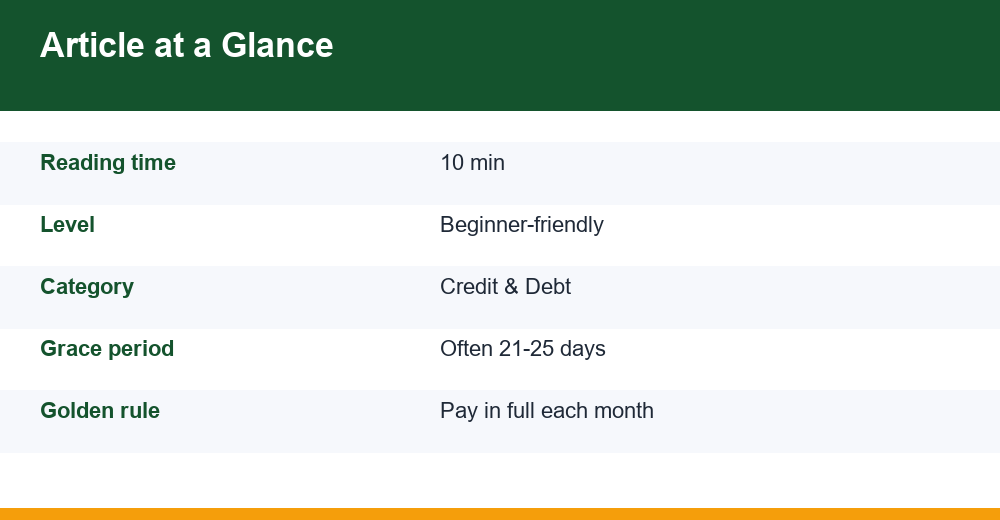
The grace period is one of the friendliest features a credit card has, and using it well is the secret to borrowing at no cost. It is the stretch of time between the end of your billing cycle and your payment due date, often around 21 to 25 days, during which purchases do not yet attract interest.
Here is the important catch. The grace period usually only applies when you started the cycle with a zero balance. If you pay your statement balance in full and on time, that grace period rolls forward and your new purchases stay interest-free. But once you carry a balance from one month into the next, many cards suspend the grace period, and interest can begin on new purchases straight away.
Interest is expressed as an APR, or annual percentage rate. Card issuers usually break that yearly rate down into a daily rate and apply it to your balance each day you carry one, which is why debt can grow faster than people expect. Cash advances and balance transfers often have no grace period at all, so interest can start the moment the money leaves the card.
For a neutral, jargon-free explainer of billing and interest rules, the U.S. Consumer Financial Protection Bureau is a reliable starting point: consumerfinance.gov. Treat any specific rate you see anywhere as an example only, since your actual APR depends on your card and circumstances.
Minimum Payments and the Slow-Debt Trap
The minimum payment is the smallest amount you can pay each month while keeping your account in good standing. It is often a small percentage of your balance, sometimes just a few percent. Paying it protects your credit record, but it does something quietly costly at the same time: it leaves most of your balance in place, still gathering interest.
Because interest is charged on whatever you carry, paying only the minimum can stretch a modest balance across years and multiply what you ultimately hand over. The table below uses illustrative figures only on an example balance to show the shape of the difference. These are not real rates or promises, just a picture of how the choice plays out.
| Repayment approach | Monthly amount | Time to clear | Interest cost |
|---|---|---|---|
| Minimum only (small %) | Starts low, then shrinks | Many years | Far more than you borrowed |
| Fixed larger amount | Steady each month | A couple of years | Much less interest |
| Pay statement in full | The whole balance | One month | Zero interest |
The takeaway is not that minimum payments are bad; they are a useful cushion in a hard month. The trap is treating the minimum as your normal plan. If a balance has already built up, a focused payoff strategy will save you the most, and our guide on how to pay off debt walks through practical methods step by step.
Common Fees Worth Knowing
Interest is the biggest cost for people who carry a balance, but fees can quietly add up too. The good news is that nearly all of them are avoidable once you know they exist. Here are the ones to keep on your radar and how to sidestep each.
| Fee | When it applies | How to avoid it |
|---|---|---|
| Annual fee | Charged yearly on some cards | Choose a no-fee card if unsure |
| Late payment | You miss the due date | Use autopay and reminders |
| Cash advance | You withdraw cash on the card | Avoid card cash withdrawals |
| Foreign transaction | Spending in another currency | Pick a no-FX-fee travel card |
| Over-limit | You exceed your credit limit | Track your balance regularly |
Before you sign up for any card, skim the summary box of rates and fees. It is usually a short, standardised table, and two minutes there can save you real money later. If a card charges an annual fee, make sure its rewards or perks genuinely outweigh the cost for the way you actually spend.
Using a Credit Card Responsibly
Now that you know how credit cards work, using one well comes down to a few steady habits rather than willpower or luck. A card is simply a tool, and like any tool it rewards a light, consistent touch.
Simple habits that keep you in control
- Pay in full whenever you can to sidestep interest entirely
- Never miss a due date; autopay for the minimum is your safety net
- Keep your balance low relative to your limit, ideally well under a third
- Treat the card like cash, spending only what you could repay this month
- Check statements monthly for errors or charges you do not recognise
It helps to fold your card spending into a plan for the whole month rather than watching it in isolation. If you have never mapped your income against your outgoings, our budgeting tips make it painless, and a simple budget is the single best guard against a balance creeping up unnoticed.
If you ever find the balance growing faster than you can manage, act early. Contact your issuer, since many offer hardship options, and lean on free, reputable resources rather than paying up front for debt help. Facing it sooner almost always costs less, in money and in stress, than waiting until the problem feels overwhelming.
One important note before you go: this article is general education, not personalized financial advice. Everyone’s circumstances differ, so for decisions that affect your budget or borrowing, consider speaking with a qualified financial professional. Any rates, fees or figures here are illustrative examples, not real offers or guarantees. And if you ever think about borrowing on a card to invest, remember that investments can fall as well as rise, so that approach carries real risk.
Finally, remember that a credit card is one part of a bigger money picture. Used gently and paid off in full, it can add convenience, protection and a stronger credit history. The moment it starts causing worry, slow down, pay down what you can, and reach out for help early rather than late.
Frequently Asked Questions
Is it better to pay off my credit card in full or leave a small balance?
Paying in full every month is best. It clears the debt, avoids all interest and still builds your credit history. The myth that you must carry a small balance to boost your score is not true; on-time full payments are what count.
What actually happens if I only pay the minimum each month?
Your account stays in good standing, but most of the balance remains and keeps gathering interest. Over time this can cost far more than you borrowed and stretch repayment across years, so treat the minimum as a cushion, not a plan.
Does using a credit card help or hurt my credit score?
It can help, if used well. Paying on time and keeping your balance low relative to your limit builds a positive record over months. Missed payments or a maxed-out card can hurt it, so steady, modest use is the goal.
When does credit card interest actually start being charged?
On purchases, interest usually starts only if you carry a balance past the due date, thanks to the grace period. Cash advances and balance transfers often have no grace period, so interest can begin the moment the transaction posts.