
The best budgeting tips are not about restriction or spreadsheets you dread opening; they are about giving every dollar a clear job so your money stops slipping away unnoticed. A budget that works bends with real life, quietly plans for the bills that only show up once a year, and still leaves room for the things you enjoy. This guide walks through fifteen practical, sustainable ways to take control.
Table of Contents
Why Most Budgets Fall Apart
Most budgets do not collapse because people are careless with money. They collapse because the plan was built for an ideal month that never actually arrives, one with no surprise bills, no last-minute dinners out, and flawless willpower. Real life is messier than that. The moment an unexpected cost appears, a rigid budget snaps, and it is tempting to give up entirely rather than adjust.
The second trap is chasing perfection instead of consistency. A meticulous budget you build once and never open again changes nothing. A rough plan you glance at every week slowly reshapes your habits without you noticing. It helps to see a budget as a living tool rather than a test you either pass or fail. Consistency quietly beats perfection every single time.
One honest note before we dig in: everything here is general educational information, not personalised financial, tax, or legal advice. Any numbers you see are illustrative examples only, never guarantees or predictions of real rates. For decisions about your own money, consider your situation and speak with a licensed professional who knows the full picture.
- Setting limits so tight they feel like punishment
- Forgetting annual or irregular bills entirely
- Tracking nothing, so overspending stays invisible
- Never adjusting categories that are always over
- Treating one bad week as total failure
A third reason budgets fall apart is that they are never spoken about, even inside a household. When one person tracks the money silently, small mismatches quietly build up until they surface as tension. A budget works best as an open agreement, revisited together, so everyone understands the plan and no single purchase ever has to feel like a secret.
15 Budgeting Tips That Actually Stick
The budgeting tips below work whether you earn a steady salary or a paycheck that swings from month to month. You do not need to adopt all fifteen at once. Start with the two or three that feel easiest, let them settle into habits, then layer on the rest over the coming weeks.
- Track every expense for one full month before changing anything, because you cannot fix spending you cannot see.
- Base your plan on your real take-home pay after tax and deductions, never your gross salary.
- Cover essentials first: housing, food, utilities, transport, and minimum debt payments come before anything else.
- Attach each savings goal to a specific reason, like a trip or a debt-free date, so the effort feels worth it.
- Automate transfers to savings on payday, so the money moves out of reach before you can spend it.
- Build a small starter emergency fund of a few hundred dollars before chasing bigger goals.
- Turn big annual bills into monthly set-asides so they never catch you off guard.
- Keep a guilt-free spending category; a little breathing room makes the whole plan sustainable.
- Audit your subscriptions every few months and cancel anything you no longer truly use.
- Give yourself a short waiting period before non-essential buys to separate real wants from passing whims.
- Plan meals and shop from a list to cut both food waste and impulse grocery spending.
- Once a year, review and renegotiate recurring bills like insurance, phone, and internet.
- If your income varies, build the plan around your lowest typical month and treat extra as a bonus.
- Check your budget for five minutes each week rather than a single panicked review once a year.
- Raise any category that is always over; a realistic plan you follow beats a perfect one you abandon.
Notice that none of these ask you to give up everything you love. A plan that leaves zero room for pleasure rarely survives its first difficult week, because deprivation is hard to sustain. If you would like a full, step-by-step walkthrough of setting one up from a blank page, see our guide on how to make a budget.
Pacing matters more than ambition here. If you try to overhaul every habit in a single weekend, the sheer effort tends to fade fast. Choosing two or three of these budgeting tips, practising them until they feel automatic, and only then adding more is what turns a short burst of motivation into a routine that quietly holds up for years.
Plan Ahead for Irregular Expenses
The bills that quietly wreck budgets are rarely the predictable monthly ones. It is the annual car service, the insurance renewal, the holiday season, and the surprise trip to the dentist. Because these costs do not arrive every month, it is easy to pretend they are not coming at all, and then reach for a credit card in a panic when they inevitably do.
A sinking fund is the calm answer. You estimate each irregular cost across the year, divide it by twelve, and quietly set that amount aside every month. By the time the bill lands, the money is already waiting for it. Here is a simple, illustrative example of how that might look:
| Irregular expense | Yearly estimate (example) | Set aside monthly |
|---|---|---|
| Car maintenance | $600 | $50 |
| Holiday gifts | $480 | $40 |
| Insurance renewal | $720 | $60 |
| Home repairs | $360 | $30 |
The figures above are sample numbers only, chosen to show the method; they are not a recommendation or a forecast of your costs. Adjust each line to match your own life, and keep this money in a separate savings pot so it is not accidentally spent on everyday expenses before the real bill arrives.
It also helps to name each sinking fund clearly, whether on paper or inside a savings app, so you always know what a given balance is for. A pot labelled for the car is far harder to raid for a spontaneous weekend away than a vague lump of general savings. Clear labels turn good intentions into money that is genuinely set aside.
Trim Waste Without Feeling Deprived
Trimming waste does not mean cutting joy. It means noticing the spending that gives you very little in return, so you can redirect that money toward things you genuinely care about. Almost everyone finds a surprising amount of quiet leakage the first time they look closely at where their money actually goes.
- Subscriptions you signed up for and forgot
- Bank or card fees you could avoid
- Impulse buys that lose their shine within a day
- Convenience spending you could easily plan around
- Food bought and then thrown away
A short pause before non-essential purchases tends to work far better than any strict ban, which usually backfires. If impulse spending is your weak spot, our guide on how to stop overspending offers practical ways to slow the moment down. The aim is always to spend on purpose, not simply to spend less for its own sake.
Redirecting even a modest amount each month adds up faster than most people expect. Rather than trying to slash everything at once, pick one or two leaks this week and plug them. Small, repeatable changes are far easier to keep than a dramatic overhaul that leaves you feeling squeezed and resentful within a fortnight.
Pick a Budgeting Method You’ll Keep Using
There is no single correct way to budget. The best method is simply the one you will still be using six months from now. Below are four popular approaches, so skim them and pick whichever fits the way your brain naturally likes to handle money.
| Method | How it works | Best for |
|---|---|---|
| 50/30/20 rule | Split income into needs, wants, and savings | A simple starting point |
| Zero-based | Give every dollar a job until you reach zero | Detail-oriented planners |
| Envelope / cash | Cash or digital envelopes per category | Curbing overspending |
| Pay-yourself-first | Save a set amount first, spend the rest | Steady, hands-off savers |
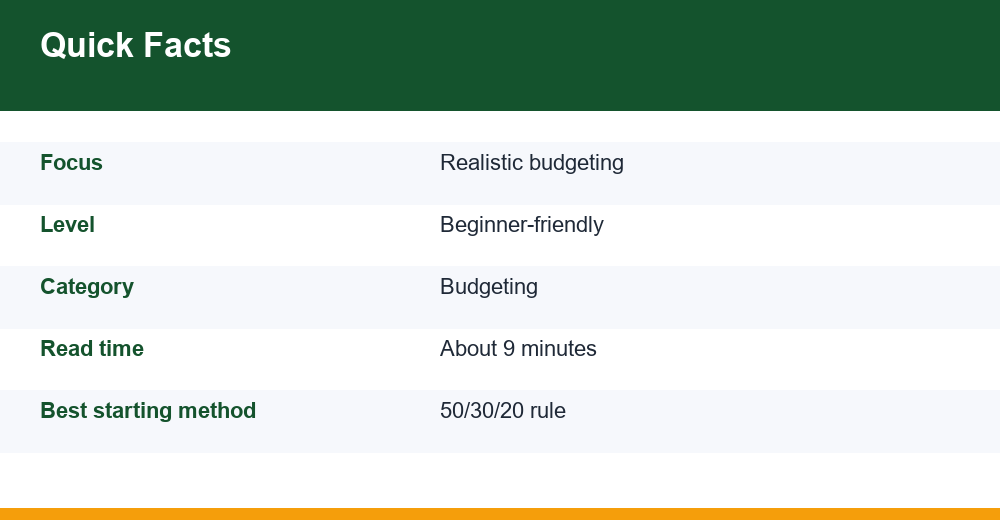
If you are unsure where to begin, the 50/30/20 rule is a gentle on-ramp: roughly half your take-home pay for needs, about a third for wants, and the remainder for savings and debt. These percentages are illustrative guidelines, not fixed targets, so feel free to bend them until they fit your actual income and costs.
You are also allowed to mix methods. Many people pair the simplicity of 50/30/20 with cash envelopes for the categories where they tend to overspend. The plan is yours to shape, and adjusting it as your life changes is a sign it is working, not a sign it is failing.
Whichever approach you choose, give it a fair trial before deciding it does not work. A method can feel awkward for the first week or two simply because it is new, not because it is wrong for you. Commit to a full month, notice where it snags, and make small adjustments rather than abandoning the whole system at the first sign of friction.
How to Stay on Track Month After Month
Building a budget is the easy part; keeping it alive is where the real payoff lives. Revisit these budgeting tips with a short, regular check-in, and your plan stays connected to what is genuinely happening in your account rather than drifting into wishful thinking. A few minutes a week is plenty.
- Pick a set day each week for a five-minute review
- Compare planned versus actual spending, without judgement
- Move money between categories when life shifts
- Celebrate small wins to keep yourself motivated
- Reset quickly after an off week instead of quitting
For trustworthy, plain-language money guidance, the U.S. Consumer Financial Protection Bureau offers free budgeting worksheets and tools at consumerfinance.gov. It is a solid, non-commercial reference to lean on when you want a neutral second opinion, especially on topics like debt, saving, and avoiding common money traps.
If you slip one week, and at some point you will, the trick is to reset the very next day rather than declaring the whole budget a failure. One overspent afternoon does not undo a month of steady effort. The people who succeed are simply the ones who keep coming back to the plan.
Tools and Support That Make It Easier
You can run a perfectly good budget with a paper notebook or a free spreadsheet, and plenty of people do exactly that for years. But if manual tracking feels like a chore you will abandon, the right app can turn these budgeting tips into something almost automatic, syncing your accounts and sorting transactions so you do the thinking, not the data entry.
The best choice depends on whether you want deep, hands-on control or a relaxed overview. Our roundup of the best budgeting apps compares the leading options so you can match one to your style. Whatever you pick, keep in mind that investing any spare savings carries risk, including the possible loss of the money you put in, so weigh those choices carefully and seek qualified advice when the stakes are high.
Whatever you use, remember that the tool is not the budget; your decisions are. An app can show you where money went and remind you what is left, but it cannot choose your priorities for you. Treat any software as a helpful assistant rather than an autopilot, and keep reviewing the numbers yourself so you stay firmly in charge of the plan.
Frequently Asked Questions
How much of my income should go to savings?
A common starting point is the 50/30/20 rule, which sets aside about 20 percent of take-home pay for savings and debt. It is only a guide, though. Adjust the split to fit your income, costs, and goals, and treat the figure as illustrative rather than a target you must hit exactly.
What is the easiest budgeting method for beginners?
Many people find the 50/30/20 rule easiest because it uses just three simple categories. If you tend to overspend, an envelope or cash system can help you feel each limit more clearly. Try one method for a month, then switch if it does not suit how you naturally think about money.
How do I budget when my income changes every month?
Base your plan on your lowest typical month so essentials are always covered, and treat any extra income as a bonus for savings or debt. Keeping a small buffer account smooths out the gaps between higher and lower earning months, so a slow period does not knock your whole plan over.
Is budgeting worth it if I do not earn much?
Yes. A budget matters most when money is tight, because it helps you decide what to cover first and avoid costly surprises. Remember this is general educational information, not personalised advice; a qualified professional can help with decisions that fit your own situation and goals.