Learning how to make a budget is simply deciding where your money goes before the month begins, instead of wondering where it went afterwards. This warm, step-by-step guide walks you through seven easy stages, from adding up your income to sticking with the plan, so managing money feels calm and clear rather than stressful or restrictive.
Table of Contents
What a Budget Really Is (and Isn’t)
A budget has a bit of an image problem. Many people picture it as a strict set of rules that quietly cancels every small pleasure. In reality, a budget is just a plan for your money: a way of telling each dollar where to go so it supports the life you actually want to live.
It helps to think of it less as a diet and more as a map. A good budget does not scold you for buying coffee or booking a weekend away. It simply shows you what is coming in, what is going out, and whether the two are balanced. That clear-eyed awareness is where real financial calm begins.
That is the quiet secret behind how to make a budget that lasts: it should reflect your own priorities, not someone else’s idea of how you ought to spend. When the plan fits your life, following it stops feeling like a struggle.
Perhaps the biggest benefit is peace of mind. When you can see the whole picture in one place, money stops being a vague worry in the background. You trade guesswork for facts, and facts are far easier to act on. Even when the numbers are tight, knowing exactly where you stand is calmer than not knowing at all.
A budget that works well tends to do a few things for you:
- You know whether you can truly afford something before you buy it, so purchases feel good instead of guilty.
- Surprise bills feel less like emergencies and more like ordinary line items you have already planned for.
- Saving for goals, whether a trip, a home deposit, or an emergency fund, starts to happen almost on its own.
- Money becomes less of a source of arguments, worry, and late-night guilt.
How to Make a Budget in 7 Easy Steps
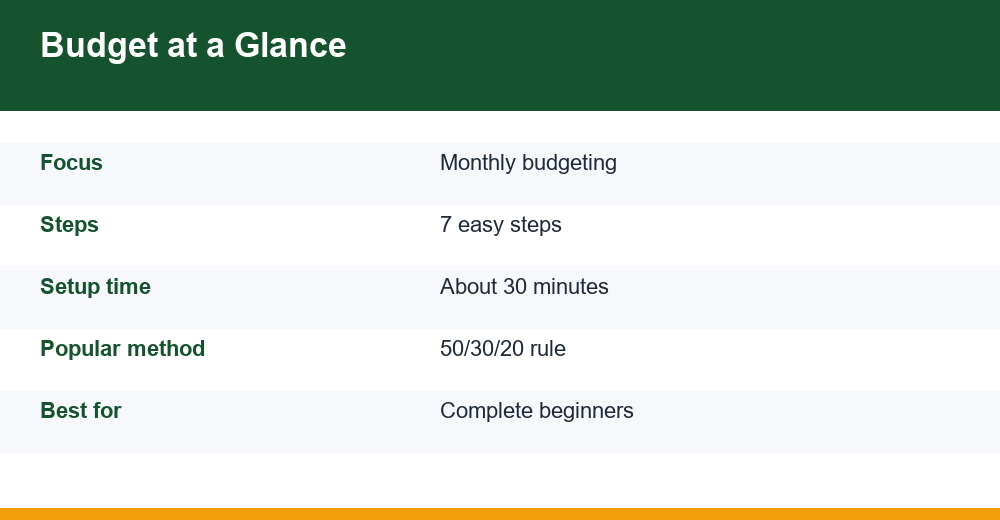
Ready to build your plan? Here is the whole process, broken into seven manageable steps. You can work through them in about half an hour with a notebook, a spreadsheet, or a budgeting app, whichever feels most natural to you. There is no need to do it perfectly the first time.
Step 1: Add up your take-home income
Start with the money that actually lands in your account each month after tax and deductions, not your headline salary. If your income varies, look back over the last three to six months and use a cautious average, or even your lowest recent month, so your plan still holds up when work is quiet.
Step 2: List everything you spend
Gather the last month or two of bank and card statements and write down every outgoing. Group them into fixed costs such as rent, insurance, and loan payments, and variable costs such as groceries, fuel, and fun. Do not forget occasional bills like car registration or birthday gifts; divide those by twelve so they never ambush you.
Step 3: Separate needs from wants
Go through your list and mark each item as a need or a want. Needs keep a roof over your head and food on the table; wants simply make life more enjoyable. Neither category is bad, but seeing the split clearly makes it far easier to decide where to trim if the numbers are tight.
Step 4: Choose a budgeting method
Pick a simple framework to organise the plan. The 50/30/20 rule, zero-based budgeting, and the envelope system are the most popular choices. We compare them in the next section so you can pick one that suits your temperament instead of fighting against it.
Step 5: Give every dollar a job
Assign your income across your categories until the money coming in matches the money going out, savings included. If you finish with a negative number, something has to change. If you finish with a surplus, send it towards a goal on purpose rather than letting it quietly drift away.
Step 6: Automate your savings and bills
Set up automatic transfers so your savings leave your account the day you get paid, before you have a chance to spend them. Paying yourself first is one of the most reliable ways to build a cushion, and our guide to saving money without feeling deprived has plenty of gentle, practical ideas.
Step 7: Track and adjust as you go
A budget is a living document, not a stone tablet. Check in for a few minutes each week, compare your plan against what really happened, and tweak the numbers. Your first month or two are rough drafts, and needing to adjust them is completely normal, not a sign of failure.
That is the full method. None of these steps is hard on its own, and together they give you a plan you can trust. Take them at your own pace, since there is no prize for rushing and no penalty for starting small.
Choosing a Budgeting Method That Fits You
There is no single correct answer to how to make a budget; the best method is simply the one you will keep using. Below are four popular approaches, each suited to a different personality. If you are unsure, start with the 50/30/20 rule for its simplicity and switch later once you know your habits.
| Method | How it works | Best suited to |
|---|---|---|
| 50/30/20 rule | 50% needs, 30% wants, 20% savings and debt | Beginners who want simplicity |
| Zero-based | Every dollar assigned until income minus spending is zero | Detail-lovers who like control |
| Cash envelope | Cash or digital pots set aside for each category | Spenders who need firm limits |
| Pay yourself first | Save a set amount first, then spend the rest freely | Busy people who dislike tracking |
Each method reaches the same destination, a plan where spending and saving stay in balance, but they take different roads to get there. Feel free to blend them. Many people use the 50/30/20 split for structure while automating their savings in true pay-yourself-first style.
Whichever route you choose, small daily habits make the biggest difference over time. You will find a whole stack of them in our collection of practical budgeting tips for everyday life.
Remember that your first choice is not permanent. If a method starts to feel like a chore after a month or two, treat that as useful information rather than failure. Swap to another approach and keep whatever worked. The best method is the one that quietly fits into your week without much fuss.
An Example Monthly Budget
To make this concrete, here is a purely illustrative example for someone bringing home $3,000 a month and using the 50/30/20 rule. These figures are invented to show the shape of a plan; your own numbers, prices, and priorities will look different.
| Category | Type | Example amount |
|---|---|---|
| Rent | Need | $1,050 |
| Groceries and utilities | Need | $450 |
| Dining out and hobbies | Want | $500 |
| Subscriptions and shopping | Want | $400 |
| Savings and debt | Goal | $600 |
| Total | $3,000 |
Notice how this plan balances to zero, with every dollar given a purpose. Here the needs come to 50%, wants to 30%, and savings to 20%, but in real life your categories will rarely split into such tidy percentages, and that is perfectly fine. The goal is a plan you can genuinely follow, not a flawless spreadsheet.
If your own income is higher or lower, the same percentages still scale. Someone earning more might send extra money toward savings or paying down debt faster, while someone on a tighter budget may lean on the needs column and keep wants small for a while. The framework bends to fit your reality.
How to Actually Stick With Your Budget
Building the plan is the easy part; living with it is where most budgets quietly fall apart. The encouraging news is that sticking with a budget is a skill you can build, and a handful of small tactics make it far more forgiving.
- Check in for five minutes a week rather than agonising over everything once a month.
- Build in a guilt-free ‘fun money’ category so the plan never feels like punishment.
- Use a sinking fund, a little set aside each month, for big irregular costs so they never blow the month apart.
- Expect to overspend sometimes. Adjust and carry on rather than tearing the whole plan up.
If one particular category keeps running over month after month, that is worth a closer look rather than a shrug. Our guide on how to stop overspending digs into the small, easily-missed triggers that quietly drain a budget.
It also helps to make your budget easy to see. Whether that is an app on your phone, a note on the fridge, or a simple spreadsheet, a plan you glance at often is a plan you are far more likely to follow.
Above all, remember that how to make a budget work for real life is mostly about kindness and consistency, not heroic bursts of willpower. A plan you return to gently, again and again, will always beat a perfect one you abandon after a hard week.
Common Budgeting Mistakes to Avoid
Almost everyone hits the same few snags when they start out. Knowing them in advance takes away much of their sting, so you can sidestep the potholes rather than falling into each one yourself.
- Forgetting irregular bills. Annual and quarterly costs sink more budgets than everyday spending ever does.
- Being too strict. A plan with zero room for enjoyment rarely survives past the second week.
- Chasing perfection. A rough budget you actually use always beats a flawless one you quietly abandon.
- Never tracking. A budget you set once and never revisit is really just a hopeful wish.
- Comparing yourself to others. Your budget only has to work for your life, your income, and your goals.
If you have made any of these already, you are in very good company. Every one of them is easy to fix, and none of them means you are bad with money. They are simply the ordinary bumps of learning a new and genuinely useful skill.
Reviewing and Adjusting as Life Changes
Your budget should grow up alongside you. A pay rise, a new baby, a house move, a change in your rent, or shifting prices at the shops are all signals to revisit your plan and rebalance the numbers so they match the life you are actually living now.
It also helps to keep learning from trustworthy, non-commercial sources. The U.S. Consumer Financial Protection Bureau offers free, plain-language budgeting and money tools that pair nicely with the steps in this guide.
Once you have done it a couple of times, how to make a budget stops feeling like a chore and starts to feel like second nature. You will spend with less guilt, save with less effort, and meet surprises with more calm than before.
One last, important note: this article is general educational information, not personalised financial, tax, or legal advice. Everyone’s situation is different, so please consider your own circumstances and speak with a licensed or qualified professional before making big money decisions. If a decision involves investing, remember that all investing carries risk, including the possible loss of money. Any figures shown here are illustrative examples only, never guarantees or predictions.
Frequently Asked Questions
How much of my income should I put towards savings?
A common starting point is the 50/30/20 rule, which sets aside 20% of your take-home pay for savings and debt. If that feels out of reach, begin with any amount, even 2%, and raise it slowly. Consistency matters far more than hitting an exact percentage right away. This is general information, not personalised advice.
What is the easiest budgeting method for beginners?
For most beginners, the 50/30/20 rule is the gentlest place to start: half your income for needs, a third for wants, and the rest for savings and debt. It gives useful structure without demanding that you track every single transaction each and every day.
How do I make a budget with an irregular income?
Base your plan on a cautious figure, such as your average monthly income over the past six months, or even your lowest recent month. Cover your essentials first, then add wants and extra savings in the months you earn more. This keeps your leaner months calm and manageable.
What should I do if my budget doesn’t balance?
If spending is higher than income, look first at large wants and recurring subscriptions, since trimming there adds up quickly. If essentials alone exceed your income, focus on raising income or seeking support, and be patient and kind with yourself while things gradually adjust.