The envelope budgeting system is one of the oldest money methods around: you split your income into labeled envelopes, one per spending category, and when an envelope is empty, that category is done until the next payday. It still works in 2026, even though most people now pay rent online, run subscriptions on a card and sometimes get paid at odd times. This guide shows how to set it up in seven steps and how to choose between cash, digital and hybrid versions.
Table of Contents
How the envelope budgeting system works
The idea is simple. Each time you’re paid, you decide in advance where every dollar will go and put that amount into a separate container. The container can be a paper envelope, a savings sub-account or a category in an app. What matters is the hard spending limit each one sets.
A normal budget tells you what you planned to spend. Envelopes show what you have left, and they show it before you buy. If the dining-out envelope has $18 in it on the 20th, you know exactly what kind of dinner you can afford. You don’t find out three weeks later from a statement.
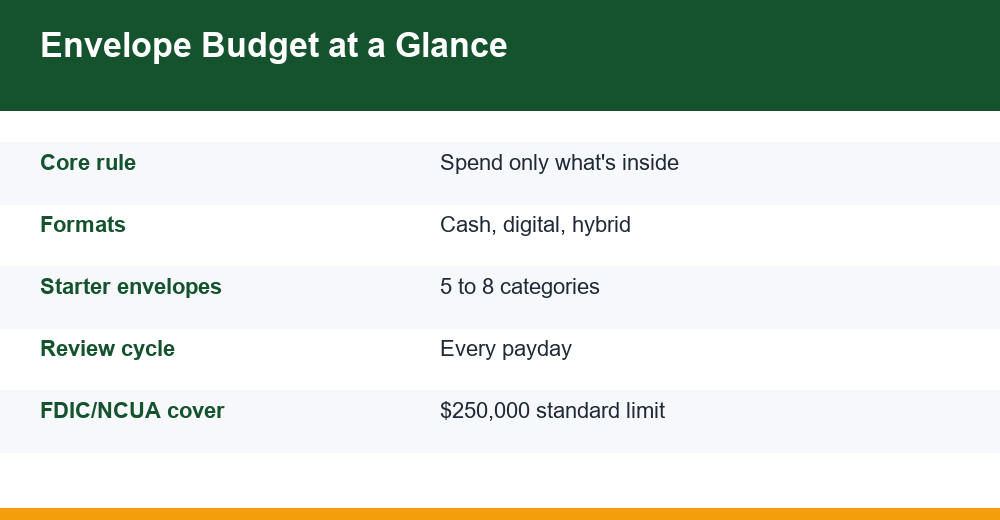
Three rules keep the system honest:
- Fund before you spend. Money goes into envelopes on payday, not after you’ve already spent it.
- Spend only from the matching envelope. Grocery money pays for groceries, not concert tickets.
- Empty means stop, or move money on purpose. You can shift money between envelopes, but you decide to do it. It doesn’t happen by accident.
That third rule is what makes it different from just watching a banking app. Every overspend forces a trade-off you can see, so the method works best on variable spending: groceries, fuel, eating out, household items and fun money. Those are the categories where small purchases quietly add up.
7 steps to set up your envelopes
You can have a working system in an afternoon. The first month will be rough, and that’s expected. By month three your numbers will usually be much closer to reality.
- Find your take-home pay. Use net income after tax, retirement contributions and insurance deductions, and note how often it arrives.
- List fixed bills. Rent or mortgage, utilities, insurance, loan minimums and phone. These are usually paid automatically and need a plan, but they may not need a physical envelope.
- Track one or two months of variable spending. Pull the last 30 to 60 days of bank and card transactions and group them. Most people underestimate groceries and eating out.
- Choose your envelopes. Start with 5 to 8 categories. Too many and you’ll stop maintaining them.
- Assign amounts per pay period. If you’re paid every two weeks, divide monthly amounts so each paycheck funds its share. Income minus all envelopes should equal zero.
- Pick a format. Cash, digital sub-accounts, an app, or a mix (compared below).
- Review every payday. Spend 15 minutes checking balances, moving leftovers and adjusting amounts that were clearly wrong.
If you need a starting point for the amounts, the 50/30/20 budget rule gives you a rough split between needs, wants and savings that you can then break into envelopes. For free, non-commercial worksheets that help with step 3, the Consumer Financial Protection Bureau’s consumer tools are a good place to start.
A sample biweekly split
Here’s an illustrative example for someone taking home $2,000 every two weeks. The figures are made up to show the structure, not recommended amounts.
| Envelope | Per paycheck | Format | Notes |
|---|---|---|---|
| Rent share | $750 | Digital (auto-pay) | Half of monthly rent |
| Utilities and phone | $140 | Digital (auto-pay) | Average of recent bills |
| Groceries | $260 | Cash or debit | Weekly shop |
| Fuel and transit | $90 | Debit | Varies with season |
| Dining out | $80 | Cash | The usual leak |
| Household and personal | $60 | Cash | Toiletries, cleaning |
| Subscriptions | $35 | Digital | Streaming, apps |
| Annual costs (sinking fund) | $125 | Digital savings | Car registration, gifts |
| Emergency fund | $200 | Digital savings | Separate account if possible |
| Fun money | $60 | Cash | No questions asked |
| Debt extra payment | $200 | Digital | Above the minimums |
Total: $2,000. Every dollar has a job, and that’s the point. Someone paid monthly would use the same structure with roughly double the amounts per envelope.
What categories should you use for envelopes?
Pick categories based on where you overspend, not on what a template lists. If you never overspend on clothing, a clothing envelope just adds admin. If takeout wrecks your month, it gets its own envelope even if the amount is small.
Categories that usually work well with cash or a tight digital limit:
- Groceries: often the biggest variable cost for a household
- Dining out and takeout, including coffee runs
- Fuel (though many people keep this on a card for convenience at the pump)
- Household and personal care: toiletries, cleaning supplies, haircuts
- Entertainment and hobbies
- Kids: school fees, activities, allowances
- Gifts, if birthdays tend to sneak up on you
- Personal fun money, one per adult, with no justification required
Fun money matters more than it looks. A budget with zero personal spending tends to collapse quickly. A small, guilt-free envelope makes the rest of the system much easier to stick to.
Bigger, less frequent expenses such as car repairs, insurance premiums and holidays belong in longer-term envelopes. Those are really sinking funds: you add a set amount each paycheck so the cost is already covered when it comes due.
Cash, digital or hybrid: picking your envelope budgeting system
Most guides describe only the paper-and-cash version. That can work, but it isn’t the only way to run an envelope budgeting system. Below are three realistic setups.
Cash stuffing
You withdraw cash on payday and divide it into labeled envelopes or a binder with zip pockets. Handing over physical bills makes spending feel real, and many people find that’s the most effective brake on impulse buys. You can also run it without a phone or internet connection.
The downsides: you can’t pay rent, streaming or online orders with cash, you carry money around, and you give up card protections and rewards on those purchases.
Can you do envelope budgeting digitally?
Yes, and there are two main ways to do it:
- Multiple bank sub-accounts. Many online banks and credit unions let you open several savings accounts or “buckets” under one login and nickname each one (“Car insurance”, “Christmas”). Your paycheck can be split across them by direct deposit or automatic transfer.
- Budgeting apps. Apps built on envelope or zero-based budgeting, such as Goodbudget or YNAB, keep your money in one or two real accounts and track virtual envelopes on top. Check current pricing and data-sharing terms before you sign up.
Digital envelopes cover online payments and keep money in insured accounts. The trade-off is that tapping a card doesn’t feel like spending. You have to check the balance before you buy, or the limits stop meaning anything.
Hybrid
This is where many people end up. Fixed and online costs (rent, utilities, subscriptions, sinking funds, savings) live in digital envelopes on auto-pay. The two or three problem categories, usually groceries, dining out and fun money, are run in cash.
| Feature | Cash stuffing | Digital envelopes | Hybrid |
|---|---|---|---|
| Brake on impulse spending | Strongest | Weakest | Strong where it counts |
| Pays online bills | No | Yes | Yes |
| Theft or loss risk | High | Low | Moderate |
| Deposit insurance on balances | None while in cash | Yes, at FDIC- or NCUA-insured institutions | Partial |
| Card rewards and dispute rights | Lost | Kept | Kept on digital side |
| Weekly effort | ATM trips, refilling envelopes | Checking app or balances | Some of both |
| Best for | Chronic overspenders | Busy, mostly-online households | Most people |
Online bills, subscriptions and annual costs
This is where cash-only systems usually break down. The fix is to treat online bills as envelopes that live in your checking account instead of a drawer.
A practical approach:
- Open a separate “bills” checking account, or use a sub-account. Every payday, transfer the exact amount needed for that period’s fixed bills.
- Point all auto-pays at that account. Your spending account then only holds envelope money, so a glance at its balance tells you something true.
- Group subscriptions into one envelope and put them on a single card or account. Seeing the combined monthly total, rather than separate $9.99 charges, often prompts a few cancellations.
- Turn annual bills into monthly envelopes. A $600 yearly insurance premium becomes $50 a month (or about $23 a paycheck if you’re paid every two weeks) into a savings envelope.
Free trials and price increases are easy to miss with subscriptions. Put a reminder on your calendar a couple of days before any trial ends, and review the subscription envelope every quarter.
If you prefer paying with a credit card for the protections or rewards, you can still use envelopes. Each time you charge something, move the same amount from the matching envelope to a “card payment” envelope, then pay the statement balance in full. If you can’t pay the full balance, switch that category to debit or cash, because interest charges usually wipe out any rewards.
What if an envelope runs out before payday?
It will happen, especially in the first two or three months. It doesn’t mean the method failed. It’s exactly the information you set up the system to give you.
When an envelope is empty, you have three choices, in this order:
- Wait. If it’s dining out or entertainment, the answer is usually no until payday.
- Borrow from another envelope. Move money from a lower-priority category, such as fun money, into groceries. It’s allowed, but write it down so you can see the pattern.
- Adjust next period’s amounts. If groceries run out every single time, the envelope is too small. Raise it and cut something else.
What to avoid: dipping into the emergency fund for wants, or putting the shortfall on a credit card you can’t pay off. If one category keeps running dry, our guide on how to stop overspending covers the habits and triggers behind it.
When you have money left at the end of a period, you can roll it over within that category, move it to savings or debt, or put it toward a goal. Rolling over grocery money is useful because it builds a buffer for expensive weeks, such as holidays.
Does envelope budgeting work with irregular income?
It does, and it can suit freelancers, gig workers, people on commission and seasonal workers well, provided you change one thing: fund envelopes by priority, not by date.
Here’s how to adapt the envelope budgeting system to uneven pay:
- Calculate your bare-minimum month. Add up housing, utilities, insurance, groceries, transport and minimum debt payments. That’s your baseline.
- Rank your envelopes. Essentials come first, then taxes, then savings and debt, then wants.
- Fill top-down as money arrives. Each payment fills the highest unfilled envelope. In a lean month, the fun envelopes stay empty.
- Build an income-smoothing buffer. Keep a holding envelope with roughly one month of baseline costs, and pay yourself a steady “salary” from it. Good months refill it; slow months draw it down.
- Set aside tax money if you’re self-employed. No employer withholds tax for you, so put a share of every payment into a dedicated tax envelope. The IRS generally expects quarterly estimated payments from people who will owe $1,000 or more, and a tax professional can help you pick the right percentage.
Digital envelopes are usually the better fit here. Payments arrive by bank transfer at unpredictable times, and moving money between sub-accounts is quicker than ATM trips.
Is cash stuffing safe? Risks and trade-offs
Cash stuffing is a solid spending discipline, but storing a lot of cash carries risks people often underestimate.
- No deposit insurance. Money in a bank or credit union is covered by the FDIC or NCUA, up to the standard $250,000 per depositor, per insured institution, for each ownership category. Cash at home or in your bag isn’t covered if it’s lost, stolen or burned.
- Theft and loss. A dropped envelope or a break-in can’t be reversed. Homeowners and renters policies often cap cash coverage at a low amount, so check yours.
- No dispute protection. Federal law gives credit and debit card users ways to dispute unauthorized or incorrect charges. Cash has none of that.
- Lost growth. Savings kept in envelopes earn nothing, while an interest-bearing savings account pays something.
- Social media pressure. Cash-stuffing content often shows large stacks and decorative binders. You don’t need either, and showing your cash publicly isn’t a good idea.
To lower the risk, keep only one pay period of spending cash in envelopes and keep savings, sinking funds and emergency money in insured accounts. Store envelopes somewhere discreet, take only the envelope you need when you go out, and refill from the bank on each payday rather than building up a stash.
Used this way, the envelope budgeting system gives you the psychological brake of cash on the categories that need it, without leaving your savings exposed. This article is general education, not personal financial advice.
Frequently Asked Questions
How does the envelope budgeting system work?
You divide each paycheck into categories such as groceries, dining out and bills, and put the planned amount into a separate envelope, sub-account or app category. You spend only from the matching envelope. When one is empty, you either stop spending in that category until payday or deliberately move money from another envelope.
Is cash stuffing safe?
It’s safe as a spending habit, but cash kept at home isn’t insured by the FDIC or NCUA and can’t be recovered if lost or stolen. Keep only one pay period’s spending money in cash, store it discreetly, and keep savings, sinking funds and emergency money in an insured bank or credit union account.
Can you do envelope budgeting digitally?
Yes. You can open several nicknamed savings sub-accounts at a bank or credit union and split your paycheck across them, or use a budgeting app that tracks virtual envelopes on top of your real accounts. Digital setups handle online bills and subscriptions well, but you need to check balances before buying.
Does envelope budgeting work with irregular income?
Yes. Rank envelopes by priority, starting with housing, utilities, food and taxes, and fill them from the top as each payment arrives. Build a buffer of about one month’s essential costs and pay yourself a steady amount from it. Self-employed people should also keep a separate envelope for estimated taxes.