The 50 30 20 budget rule splits your take-home pay into three buckets: half for needs, 30% for wants and 20% for savings and extra debt payments. It is simple enough to set up in an afternoon, but it was never meant to fit every paycheck. This guide runs the numbers at five income levels, shows where the split breaks, and gives you five practical tweaks for when it does.
Table of Contents
What Is the 50 30 20 Budget Rule?
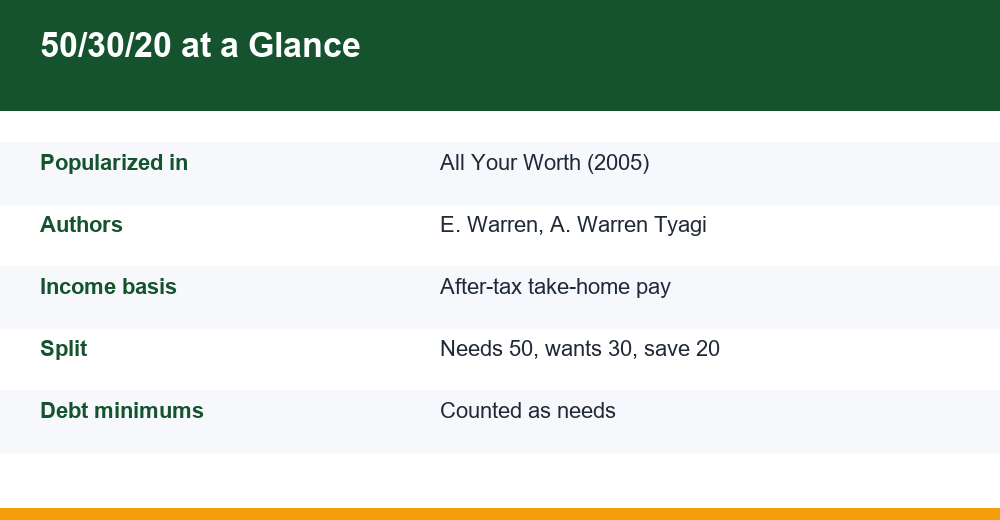
The rule was popularized by Elizabeth Warren and her daughter, Amelia Warren Tyagi, in their 2005 book All Your Worth: The Ultimate Lifetime Money Plan. Instead of tracking dozens of categories, you sort every dollar of take-home pay into three groups and aim for a target share in each.
- Needs (50%): bills you must pay to live and work, such as rent or mortgage, utilities, basic groceries, insurance, transportation to your job and minimum payments on debts.
- Wants (30%): anything you could cut without real harm, including dining out, streaming services, travel, hobbies, upgrades and most shopping.
- Savings and debt payoff (20%): emergency fund deposits, retirement contributions, investing, and any payment on a debt above the required minimum.
Treat the 50% and the 30% as ceilings and the 20% as a floor. Spending less than half on needs is a win. Saving more than a fifth is a win. The percentages are guardrails, not a grade.
The appeal is obvious. You do not need to log every coffee. You only need to know whether your fixed costs fit inside half your pay, and whether a fifth of it leaves your checking account for your future self each month.
It also gives you a quick diagnostic. If needs sit at 65%, you know the pressure point is housing, transport or debt, not the occasional takeout order. That alone stops a lot of misplaced guilt.
Gross or Net Income: Which Number Do You Split?
The original method uses after-tax income, meaning what is left after federal, state and local income taxes plus Social Security and Medicare withholding. Splitting your gross salary is one of the most common mistakes people make with this method, and it quietly overstates how much you can spend.
Here is a simple illustration. Say your gross pay is $5,000 a month and your paycheck lands at $3,900 after taxes. Half of gross is $2,500 for needs. Half of net is $1,950. Budget off the gross number and you have planned to spend $550 a month that you never actually receive.
What about 401(k) and health premiums taken from your paycheck?
Many paychecks also have pre-tax deductions removed before the money reaches you. A cleaner way to handle them:
- Start with your net deposit from a typical pay stub.
- Add back retirement contributions (401(k), 403(b)) and count them toward your 20% savings bucket.
- Add back health, dental and vision premiums and count them as needs.
- Use that adjusted figure as the income you split.
This keeps the math honest. If you skip the add-back, a worker putting 6% into a 401(k) looks like they save nothing, when in fact they are already partway to the 20% target.
Self-employed or paid by the gig?
Freelancers usually receive gross payments with no withholding. Set aside money for income and self-employment taxes first, then split what remains. Many people park that tax share in a separate savings account so it never feels spendable.
The 50 30 20 Budget Rule at Five Income Levels
The table below applies the split to five monthly take-home amounts. These are plain arithmetic, not recommendations. The last column is the useful part: it shows whether the needs cap is realistic once rent enters the picture.
| Monthly take-home | Needs (50%) | Wants (30%) | Savings/debt (20%) | Reality check |
|---|---|---|---|---|
| $2,400 | $1,200 | $720 | $480 | Rent alone often exceeds the needs cap |
| $3,500 | $1,750 | $1,050 | $700 | Works with roommates or modest rent |
| $5,000 | $2,500 | $1,500 | $1,000 | Fits in many mid-cost areas |
| $7,500 | $3,750 | $2,250 | $1,500 | Comfortable unless housing is high-cost |
| $10,000 | $5,000 | $3,000 | $2,000 | Wants cap may be generous; save more |
For context, Bureau of Labor Statistics Consumer Expenditure Survey data for 2024 show housing and transportation together making up roughly half of average household spending. That is half of total spending, before groceries, insurance or debt minimums. It explains why so many people blow through the needs bucket without being careless.
A worked month at $3,500
Take a single renter clearing $3,500. Needs might look like this: rent $1,150, utilities and phone $180, groceries $350, car payment and insurance $380, minimum on a credit card $40. Total: $2,100, or 60% of income.
That is $350 over the needs cap. Under a strict reading, the extra has to come out of wants, leaving $700 for fun and $700 for savings. That is still a workable plan. The point is to see the trade-off clearly instead of pretending the needs line is lower than it is.
A worked month at $7,500
Now a couple clearing $7,500 with a $2,400 mortgage payment, $250 in utilities, $700 in groceries, $500 for two cars and $300 for insurance. Needs total $4,150, or about 55%. Trimming wants to $1,850 keeps savings at the full $1,500. A higher income does not guarantee an easy fit; housing usually decides it.
Is Debt Repayment a Need or Savings?
Both, depending on the dollar. The required minimum payment on any debt is a need, because skipping it brings late fees, credit damage and possibly collections. Every dollar you pay above the minimum goes in the 20% bucket, since it improves your net worth just as saving does.
- Car loan minimum: needs.
- Student loan scheduled payment: needs.
- Credit card minimum: needs.
- Extra $200 toward the card balance: savings and debt payoff.
- Extra principal on a mortgage: savings and debt payoff.
Gray areas worth deciding once
Some expenses do not sort neatly. Decide how you will treat them, write it down, and stay consistent so month-to-month comparisons mean something.
| Expense | Usually | Why |
|---|---|---|
| Basic phone plan | Need | Required for work and safety |
| Premium phone upgrade | Want | The upgrade is optional |
| Groceries | Need | Basic food is essential |
| Restaurant meals | Want | Convenience, not survival |
| Gym membership | Want | Unless medically required |
| Childcare while you work | Need | Lets you earn income |
| Emergency fund deposit | Savings | Builds a cash cushion |
A good test: if you lost your job tomorrow, would you keep paying it? If yes, it is probably a need. If you would cancel it within the week, it is a want.
When the Split Breaks: Low Income, Pricey Cities, Heavy Debt
Most guides present the formula as if it fits everyone. It does not. Three situations regularly push needs well past 50%, and forcing the numbers in those cases only produces guilt.
Does the 50/30/20 split work on a low income?
Often not as written. Essential costs do not shrink in step with income. Rent, a basic phone plan and groceries cost roughly the same whether you earn $2,400 or $4,000 a month. At $2,400, needs can easily run 65% to 80% of take-home pay.
In that case the goal shifts. Cover needs first, keep wants small, and protect even a modest savings amount, such as $25 or $50 a month, so an emergency fund starts to form. Raising income or lowering housing costs usually does more than trimming wants.
High-cost cities
In expensive metros, rent can absorb 40% or more of a mid-level salary before anything else is paid. A 50% needs cap may be impossible without roommates or a long commute. Here, a wider needs bucket paired with a smaller wants bucket is more honest than pretending the rule fits.
Heavy high-interest debt
If you carry credit card balances at high interest rates, a 20% bucket split between saving and payoff may be too slow. Many people temporarily shrink wants to 10% or 15% and send the difference to debt. Keep a small emergency buffer so a surprise bill does not land back on the card.
Irregular income
Commission, tips and freelance work make percentages slippery because the base changes every month. Budget from your lowest typical month, and send anything above it straight to savings or debt. That way good months build a cushion instead of inflating spending.
Five Tweaks and Alternatives That Actually Work
There is no official version of any of these splits. They are common variations that keep the three-bucket simplicity while matching the budget to real life. Pick the one that fits your situation now, and revisit it when your income or costs change.
| Split | Needs | Wants | Savings/debt | Best for |
|---|---|---|---|---|
| 60/25/15 | 60% | 25% | 15% | High-cost cities, new grads |
| 70/20/10 | 70% | 20% | 10% | Low or tight incomes |
| 50/20/30 | 50% | 20% | 30% | Aggressive savers |
| 50/15/35 | 50% | 15% | 35% | Paying off high-interest debt fast |
| 80/20 | 80% (combined) | (combined) | 20% | People who hate categories |
- 60/25/15 accepts higher fixed costs while still keeping wants in check. It suits renters in expensive areas and people early in their careers.
- 70/20/10 is a survival-mode budget. It keeps a savings habit alive even when most income goes to essentials.
- 50/20/30 flips wants and savings. Higher earners who already cover needs comfortably can push savings toward retirement much faster.
- 50/15/35 is a temporary debt sprint. Once high-interest balances are gone, return to a standard split.
- 80/20, often called pay-yourself-first, moves 20% to savings on payday and lets you spend the rest freely, without separating needs from wants.
If you want more control than any percentage split offers, zero-based budgeting assigns every dollar a job each month. People who overspend with cards often do better with a cash-style envelope budgeting system, which makes the wants limit physical.
You can also combine methods. Some people use the three buckets for the big picture and envelopes only for the categories where they tend to overspend, such as groceries or dining out.
How to Set Up the Split in One Afternoon
You do not need a spreadsheet or an app to start. A recent pay stub, last month’s bank and card statements and about two hours will do. If you have never built a spending plan before, our walkthrough on how to make a budget covers the basics in more detail.
- Find your real income. Use your net deposit and add back pre-tax retirement and health deductions, as described above. If your income varies, use your lowest typical month.
- List every fixed need. Rent or mortgage, utilities, insurance, transport, groceries and debt minimums. Add them up and divide by income.
- Total last month’s wants. Go through statements line by line. Most people underestimate this number.
- Compare to the targets. Note how far each bucket sits from 50, 30 and 20.
- Automate the savings bucket. Schedule a transfer to savings or extra debt payments for the day after payday.
- Choose your split. If needs exceed 50% and cannot drop soon, adopt one of the tweaks above instead of fighting the math.
A practical trick is to use separate accounts: one checking account for bills, one for spending money, and a savings account. When the wants account is empty, the month’s fun budget is done, with no tracking required.
For free worksheets and plain-language guides on budgeting, debt and credit, the Consumer Financial Protection Bureau maintains a set of consumer tools that pair well with any percentage split.
Check in after one month. Adjust the categories that were unrealistic, not the ones that were simply uncomfortable. Applied this way, the 50 30 20 budget rule becomes a monthly check-up rather than a rigid set of limits.
Is the 50 30 20 Budget Rule Right for You?
The 50 30 20 budget rule works best for people with steady income, moderate housing costs and no crushing debt. It is a fast way to spot whether fixed costs have crept too high, and it builds a savings habit without the daily friction of tracking every purchase.
It works less well when needs sit far above half your income, when income swings widely from month to month, or when you need tight control to break an overspending pattern. In those cases, treat the rule as a diagnostic rather than a plan.
- Good fit: salaried workers, dual-income households, people new to budgeting.
- Needs a tweak: renters in high-cost cities, single-income families, recent graduates with loans.
- Consider another method: irregular or gig income, aggressive debt payoff, chronic overspending.
Whatever split you choose, the habits underneath it matter more than the percentages: know your take-home number, protect your savings first, and keep your fixed costs from quietly growing. This article is educational and is not personalized financial advice.
Frequently Asked Questions
What is the 50/30/20 rule?
It is a budgeting guideline that divides after-tax income into three parts: 50% for needs such as housing, utilities, groceries and minimum debt payments, 30% for wants such as dining out and travel, and 20% for savings and extra debt payoff. Elizabeth Warren and Amelia Warren Tyagi popularized it in their 2005 book All Your Worth.
Does the 50/30/20 rule use gross or net income?
It uses net, or after-tax, income. Splitting gross pay overstates what you can spend because taxes and payroll withholding never reach your account. A practical approach is to start with your take-home deposit, then add back pre-tax 401(k) contributions, counted as savings, and health premiums, counted as needs.
Is debt repayment a need or savings in the 50/30/20 rule?
Minimum required payments on loans and credit cards count as needs, because missing them causes fees and credit damage. Any amount you pay above the minimum belongs in the 20% savings and debt payoff bucket, since it reduces what you owe and improves your net worth in the same way saving does.
What are alternatives to the 50/30/20 budget?
Common variations include 60/25/15 for high-cost areas, 70/20/10 for tight incomes, 50/20/30 for aggressive savers and 80/20 pay-yourself-first. Beyond percentage splits, zero-based budgeting gives every dollar a specific job, and the envelope system uses fixed cash limits for each category to curb overspending.