Most budgets fail in the same way. The monthly numbers work, the discipline holds for a few months, and then the car needs tyres, the insurance renews and a birthday arrives in the same fortnight. The budget did not fail because of overspending; it failed because it only accounted for monthly costs while a meaningful share of real spending arrives annually. Sinking funds fix that by converting irregular expenses into monthly ones you have already set aside for. They are unglamorous, they take about an hour to set up, and they are the difference between a budget that survives a year and one that survives until March.
Table of Contents
What a sinking fund is
A sinking fund is money saved gradually towards a known future expense. The car insurance is £480 and renews in October, so £40 a month goes into a car insurance pot and October stops being an event.
That is the entire concept. It is saving with a label on it, and the label is what makes it work, because an unlabelled pot of savings gets quietly reallocated to whatever is most pressing.
Why the label matters more than it should
The money is identical whichever pot it sits in. What changes is the decision you make when looking at it. A balance marked car tyres is noticeably harder to spend on a weekend away than the same figure sitting in general savings, which is a quirk of how people think and worth exploiting rather than resisting.
Why it is not an emergency fund
These are routinely conflated, and keeping them separate is the single most useful distinction in the whole subject.
An emergency fund covers the unknown: job loss, illness, something genuinely unforeseen. A sinking fund covers the known but irregular: the renewal that arrives every year on the same date, the tyres that will eventually need replacing.
The difference matters because a household without sinking funds raids the emergency fund for predictable costs, and then has nothing left when a real emergency arrives. Each annual bill paid from emergency savings is a small failure that looks like success at the time.
- Emergency fund: unknown timing, unknown amount, rarely used
- Sinking fund: known timing, estimable amount, used every year
- Keep them in separate pots, however the account is structured
- Rebuild the emergency fund first if it has been raided
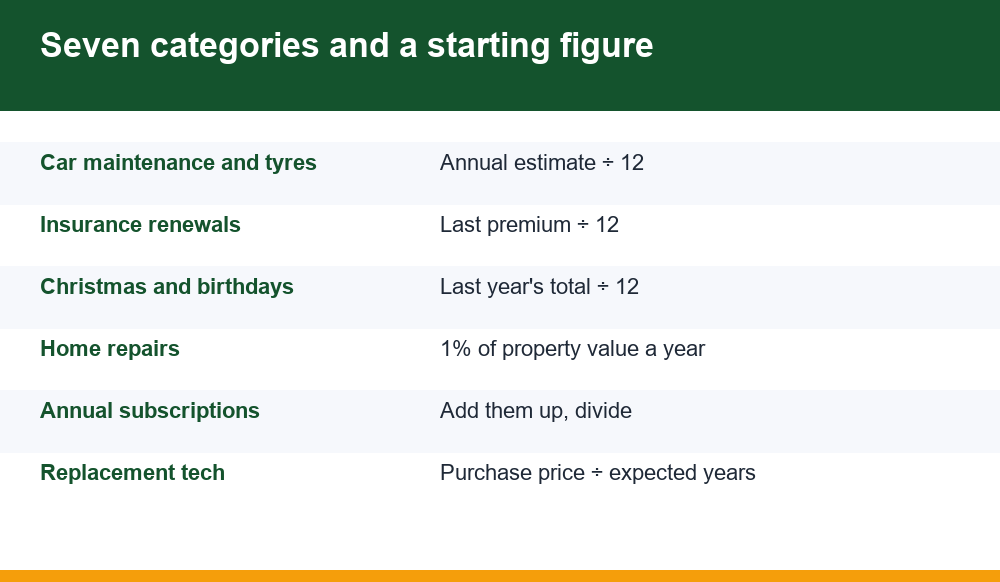
The seven categories worth starting with
These cover the expenses that most commonly break a monthly budget. Not all apply to everyone, and starting with the three that do is better than starting with all seven.
Car costs beyond fuel: servicing, tyres, the annual test, and the repair that is not quite an emergency. Insurance renewals, which are predictable to the week. Christmas and birthdays, which arrive on the same dates every year and are treated as a surprise by a remarkable number of households.
Home repairs and appliances, where the boiler is the classic case. Annual subscriptions, which have multiplied quietly and renew in a lump. Technology replacement, because a phone has a predictable lifespan. And medical and dental, which varies enormously by country but is rarely zero.
Sizing each one without guessing
The arithmetic is deliberately simple: annual cost divided by twelve. The difficulty is knowing the annual cost, and the answer is already in your bank statements.
Pull twelve months of transactions and total each category. Not an estimate, not what it should have been, the actual figure. People are consistently surprised by two of them, usually subscriptions and gifts, and the surprise is the useful part.
| Category | Sizing method |
|---|---|
| Insurance | Last premium, plus a little for the usual increase |
| Car maintenance | Last two years averaged; one year is unrepresentative |
| Gifts | Last year’s total from statements, not from memory |
| Home repairs | Around 1% of property value annually |
| Tech replacement | Purchase price divided by expected years of use |
Where there is no history, estimate high. An over-funded pot is a minor inefficiency; an under-funded one puts you back on a credit card, which is the thing this was meant to prevent.
Where to keep the money
Three approaches, in increasing order of effort and effectiveness.
One savings account with a spreadsheet tracking what each portion is for. Simplest, and it relies entirely on your own record-keeping. Separate pots or spaces within one account, which many banks and app-based accounts now offer for free and which gives the labelling effect without juggling accounts. Genuinely separate accounts, which is the strictest and the most administrative.
The pots approach suits most people. Money stays visible, each balance carries its purpose, and automatic transfers can be split across them on payday so nothing depends on remembering.
Whatever the structure, automate the transfer for the day after payday. A sinking fund funded by whatever happens to be left at month end is not a sinking fund; it is a hope. We set out the same principle for the overall split in our guide to the 50/30/20 budget rule.
Starting when you cannot fund them all
Totalling seven categories produces a monthly figure that is frequently unaffordable, and this is where most people abandon the idea. The response is to start partially rather than not at all.
- Rank the categories by how soon the expense lands and how badly it would hurt
- Fund the top two or three only, at the full monthly rate
- Add a category each time one is fully funded or something is paid off
- Treat any windfall as a chance to jump-start the next pot
- Accept that the first full year is the hard one
The first twelve months are genuinely awkward, because bills arrive before the pots have filled. After a complete cycle the system is self-sustaining, since each pot has a year’s contributions behind it. Knowing that in advance makes the difficult period survivable rather than discouraging.
The three mistakes that kill them
Too many categories. Fifteen pots each receiving a small amount produces administrative work and no meaningful buffer anywhere. Four or five well-funded pots beat fifteen token ones comfortably.
Borrowing between pots. Taking from the car fund for a holiday is the moment the system stops being a system. If a pot is persistently over-funded, resize it deliberately rather than raiding it situationally.
Not spending them. The strangest failure and a common one. People build a tyre fund and then flinch at spending it on tyres, having mentally reclassified it as savings. The fund succeeded; spending it is the point, and feeling bad about that defeats the whole exercise.
Reviewing them once a year
Sinking funds drift, because the costs they cover change and the contributions do not. An annual review takes twenty minutes and keeps the figures honest.
Compare what each pot received against what it actually paid out over the year. Pots consistently finishing empty are underfunded and the monthly figure needs raising. Pots that never go below a large balance are overfunded, and that surplus is better deployed elsewhere.
This is also the moment to close categories that no longer apply and open ones that have appeared. A car sold, a subscription cancelled, a child starting school: each changes the shape of the year, and a set of pots designed around last year’s life quietly stops matching this one.
Do the review in the same month each year, ideally just before the heaviest spending period, so any adjustment has time to take effect before it is needed. For most households that means reviewing in late summer rather than in January, when the damage has already been done.
Why the system works when willpower does not
Sinking funds are usually explained as arithmetic, and the arithmetic is trivial. What makes them effective is closer to psychology, and understanding that helps the habit survive its first difficult month.
Money behaves differently depending on where it sits and what it is called, which is irrational and entirely reliable. A balance labelled for car tyres resists being spent on a weekend away far better than the same amount in general savings, even though the two are interchangeable. Rather than fighting that tendency, sinking funds use it.
They also move a decision away from the moment of pressure. Deciding in March that tyres will cost roughly £400 over the year is a calm, arithmetic decision. Deciding in November, with worn tyres and no pot, is a decision made under duress and typically resolved with a credit card at an interest rate nobody would accept in March.
That is the whole mechanism: predictable costs get funded by the version of you with the time to think, rather than the version standing in the garage. It is the same structure as a standing order into a pension, and it works for the same unremarkable reason.
It is worth saying that none of this requires a high income. The categories scale down perfectly well, and a household funding three small pots is markedly better protected than one funding none, because the failure being prevented is a timing failure rather than a shortfall in total resources.
One practical closing note on account structure, because it determines whether any of this survives contact with a busy month. Most app-based banks and a growing number of traditional ones now offer named pots at no cost, with the ability to split an incoming payment across them automatically on a set date.
Set that up once and the system runs without you. Money arrives, the pots fill, and the only remaining decision is spending each pot on what it was labelled for. Where that automation is unavailable, a standing order into a second account on payday achieves most of the same effect with slightly more friction.
What does not work, reliably and for almost everyone, is intending to transfer the money manually each month. That is the version of this plan that lasts about four months, and it fails in exactly the month a large bill arrives, which is the month it was supposed to cover.
Finally, a word for anyone reading this while already behind. Sinking funds are a preventative measure and they do nothing about a bill that has already landed on a credit card. Clear the expensive debt first, then build the pots, because contributing to savings at two per cent while carrying a balance at twenty is arithmetic working against you.
The exception is a small starter pot, perhaps a single month of the most urgent category, built alongside the debt repayment. It is not efficient on paper and it stops the next unexpected bill going straight back onto the card, which is what turns a temporary balance into a permanent one.
Frequently Asked Questions
What is the difference between a sinking fund and savings?
A sinking fund has a specific purpose and a known timescale, which changes how you treat the money. General savings get reallocated to whatever feels urgent; a balance labelled for insurance renewal tends to survive until the renewal arrives.
Should I use a sinking fund or an emergency fund for car repairs?
Routine maintenance, servicing and tyres belong in a sinking fund, because they are predictable. A sudden major failure is closer to an emergency. Households without maintenance pots end up draining emergency savings for entirely foreseeable costs.
How many sinking funds should I have?
Four or five well-funded ones work better than fifteen token pots. Start with the categories that would hurt most if they landed next month, and add more only as each becomes fully funded or other commitments end.
Where should the money be kept?
Pots or spaces within a single savings account suit most people: the labelling effect without the administration of multiple accounts. Whatever the structure, automate the transfer for the day after payday rather than saving what is left at month end.
What if I cannot afford to fund them all?
Fund two or three at the full rate rather than all of them partially, ranked by how soon the expense lands. The first year is the awkward one because bills arrive before pots have filled; after a complete cycle the system sustains itself.