Knowing how inflation affects savings starts with one fact: the number in your account can grow while what it buys shrinks. This guide walks through the simple math of real versus nominal returns, shows where to check official inflation data, and covers six low-risk ways to protect cash, without guessing where rates go next.
Table of Contents
How inflation affects savings: the purchasing-power math
Inflation is a general rise in prices over time. When prices rise, each dollar buys a little less. That loss of buying power is the real story behind how inflation affects savings: your balance never visibly drops, but the groceries, rent and car repairs it is meant to cover get more expensive.
Take a hypothetical $10,000 emergency fund sitting in an account that pays 0.5% a year. After twelve months you have $10,050. If prices rose 3.5% over the same year, the basket of goods that cost $10,000 now costs $10,350. Your money grew by $50, but you are about $300 short of buying what you could have bought a year earlier.
In today’s dollars, that $10,050 is worth roughly $9,710. That is a real loss of about 2.9%, even though the bank statement shows a gain.
How does inflation affect my savings over many years?
One bad year is annoying. Several years in a row is where the damage compounds. The table below shows what $10,000 held at a 0% return would buy, in today’s dollars, if inflation ran at a steady 3% a year. The figures are rounded illustrations, not forecasts.
| Years held | Nominal balance | Buying power (3% inflation) | Purchasing power lost |
|---|---|---|---|
| 1 | $10,000 | about $9,709 | about 3% |
| 5 | $10,000 | about $8,626 | about 14% |
| 10 | $10,000 | about $7,441 | about 26% |
| 20 | $10,000 | about $5,537 | about 45% |
Nothing in that table involves a market crash or a bad investment. It is simply what happens to idle cash when prices keep climbing. That is why savers should judge an account by what it earns after inflation, not by the headline rate alone.
The same math works in reverse. Cash earning 3% while prices rise 3% roughly holds its ground, and cash earning more than inflation slowly gains buying power. The rate you earn is the one lever you fully control.
Nominal vs. real interest rates, explained simply
The nominal rate is the number the bank advertises, such as 4.00% APY. The real rate is what you earn after inflation is taken out. The real rate is the one that tells you whether your savings are actually gaining ground.
A quick rule of thumb works for everyday decisions:
- Real return ≈ nominal rate − inflation rate
- 4.0% APY with 3.0% inflation ≈ +1.0% real return
- 1.0% APY with 3.5% inflation ≈ −2.5% real return
- 0.01% APY with 3.5% inflation ≈ −3.5% real return
For a more precise answer, divide instead of subtracting: (1 + nominal rate) ÷ (1 + inflation rate) − 1. With a 4% rate and 3% inflation, that gives 1.04 ÷ 1.03 − 1, or about 0.97%. The shortcut is close enough when both numbers are small.
Do not forget taxes
Interest from savings accounts and CDs is generally taxable as ordinary income at the federal level and often at the state level too. If you are in a 22% federal bracket, a 4% yield becomes roughly 3.1% after federal tax. Subtract 3% inflation and your real, after-tax gain is close to zero.
That does not make saving pointless. It means the main job of cash is safety and access, not wealth building. Growth over decades usually has to come from investments that carry more risk.
Where to find official inflation numbers
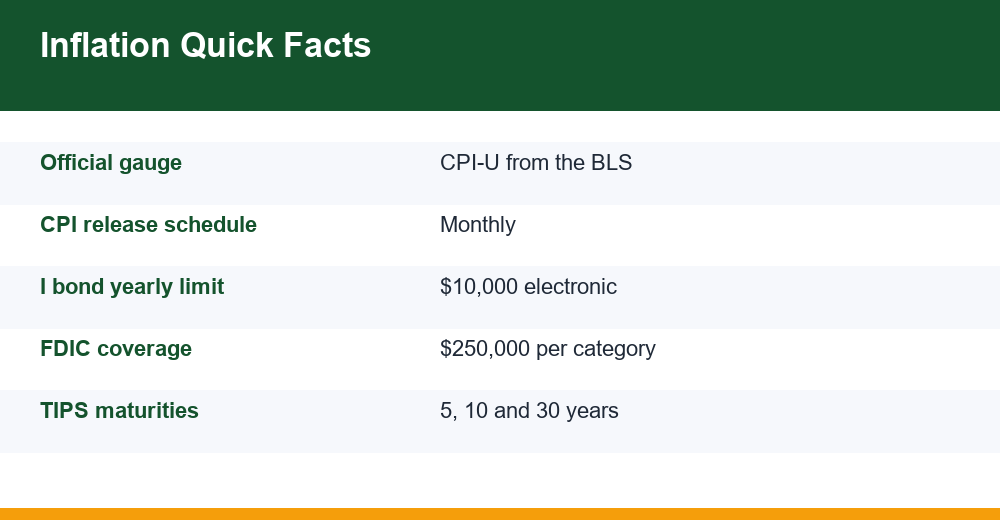
In the United States the most widely quoted inflation measure is the Consumer Price Index (CPI), published monthly by the Bureau of Labor Statistics. It tracks the average change over time in the prices urban consumers pay for a market basket of goods and services. You can check the latest release on the BLS Consumer Price Index page.
Each monthly release reports the change in the all-items index over the past month and the past 12 months, along with core CPI, which excludes food and energy. These figures move every month, so always use the newest release rather than a number you saw quoted months ago.
Which number should you use?
- Headline CPI-U: the broadest measure and the one most news reports quote. Good for comparing against your savings rate.
- Core CPI: strips out volatile food and energy. Useful for seeing the underlying trend, but your budget still pays for gas and groceries.
- Your own inflation: if rent or childcare is most of your spending, your personal rate may be higher or lower than the national average.
A practical habit is to note the 12-month CPI figure once a quarter and compare it with the APY on your savings. If the gap is wide and negative, that is how inflation affects savings in your own accounts, and it may be time to review where your cash sits.
Should you keep cash in savings when prices rise?
Yes, for the right purposes. Understanding how inflation affects savings is not a reason to empty your account. Cash is still the best tool for money you might need soon or suddenly, because it does not fall in value when markets drop and you can usually reach it within a day or two.
The real question is how much cash, and where. If you are still building your foundation, our guide to personal finance for beginners explains how emergency funds, debt payoff and investing fit together.
Match the money to its job
| Money’s purpose | Time horizon | Typical home | Inflation priority |
|---|---|---|---|
| Emergency fund | Any day | High-yield savings | Low: access comes first |
| Known bill or purchase | 3 to 24 months | CDs or Treasury bills | Medium |
| Medium-term goal | 2 to 5 years | CD ladder, I bonds, TIPS | High |
| Retirement or long-term | 5+ years | Diversified investments | Very high |
Keeping three to six months of expenses in cash is common guidance, though the right number depends on job security, health and household size. Money beyond that cushion, with no near-term job, is where inflation does the most quiet harm.
One caution: high-interest debt usually costs more than inflation erodes. Paying off a credit card charging 20% or more is a guaranteed return that no savings account can match.
Do high-yield savings accounts keep up with inflation?
Sometimes. A high-yield savings account (HYSA) pays a variable rate that tends to follow the Federal Reserve’s policy rate. When the Fed holds rates high to fight inflation, top online accounts have often paid rates near or above the inflation rate. When the Fed cuts, those yields usually fall, and inflation may not fall at the same pace.
So an HYSA is not a guaranteed inflation hedge, but it narrows the gap far more than a traditional account paying close to nothing. Our breakdown of the high-yield savings account covers how to compare APYs, fees and transfer limits.
What to check before moving money
- Insurance: FDIC coverage at banks (or NCUA share insurance at credit unions) protects up to $250,000 per depositor, per insured institution, per ownership category.
- Rate history: some banks offer a short teaser rate and then lag the market.
- Fees and minimums: a monthly fee can wipe out a large share of the interest on a small balance.
- Access: confirm how fast transfers reach your checking account.
Even when an HYSA trails inflation slightly, it still preserves far more purchasing power than cash earning nothing, while keeping your emergency fund fully liquid.
6 smart ways to protect cash from inflation
None of these options requires predicting interest rates. Each one simply trades a little flexibility or effort for a better shot at keeping pace with rising prices.
- Move idle cash out of near-zero accounts. Many traditional savings accounts still pay a tiny fraction of a percent. Shifting to a competitive HYSA is the easiest win.
- Lock in rates with CDs. A certificate of deposit fixes your rate for a set term. You give up access, and early withdrawal usually costs a penalty.
- Build a CD ladder. Splitting money across staggered maturities gives you regular access and lets you reinvest at current rates. See our CD ladder strategy guide for a step-by-step setup.
- Buy Series I savings bonds. Their rate includes an inflation component that resets every six months.
- Consider TIPS or Treasury bills. TIPS adjust principal for inflation; T-bills are short-term, and their interest is exempt from state and local income tax.
- Invest money you will not need for years. Historically, diversified stock investments have outpaced inflation over long periods, though they can lose value, sometimes sharply, in the short run.
Side-by-side comparison
| Option | Inflation link | Access | Main trade-off |
|---|---|---|---|
| High-yield savings | Indirect, rate varies | Anytime | Rate can drop |
| CDs / CD ladder | Fixed rate, no link | At maturity | Early withdrawal penalty |
| Treasury bills | Indirect, short term | 4 to 52 weeks | Rate resets at rollover |
| Series I bonds | Direct, resets twice a year | After 12 months | $10,000 yearly limit |
| TIPS | Principal tied to CPI | Hold or sell | Price moves if sold early |
| Diversified stocks | Long-run growth | Anytime | Can lose value |
Most households end up using two or three of these together rather than picking just one. A layered approach keeps emergency money liquid while letting longer-term cash work harder.
What are I bonds and TIPS?
Both are U.S. Treasury products built specifically to respond to inflation, and both are backed by the full faith and credit of the U.S. government. They work differently, though, and suit different savers.
Series I savings bonds
- The rate combines a fixed rate and an inflation rate tied to CPI; new rates are announced every May and November.
- You can buy up to $10,000 in electronic I bonds per person per calendar year through TreasuryDirect, plus up to $5,000 in paper bonds using a federal tax refund.
- You must hold them at least 12 months. Cashing out before five years costs the last three months of interest.
- Interest is subject to federal income tax but exempt from state and local income tax, and federal tax can be deferred until you redeem.
Treasury Inflation-Protected Securities (TIPS)
- Issued with 5-, 10- and 30-year maturities.
- The principal rises with CPI (and can fall with deflation). Interest is paid every six months on the adjusted principal.
- At maturity you receive the greater of the adjusted principal or the original principal.
- You can buy them at auction through TreasuryDirect or through a brokerage, and they can be sold before maturity, though the market price may be higher or lower than what you paid.
- Inflation adjustments to principal are generally taxable federally in the year they occur, even though you do not receive that money until later.
In short, I bonds are simple and capped, best for modest amounts you can leave alone for at least a year. TIPS have no small annual cap and suit larger sums, especially inside tax-advantaged retirement accounts where the yearly tax on adjustments does not apply.
A simple plan for your savings
Once you see how inflation affects savings, the response is less about chasing the highest yield and more about putting each dollar in the right place. A short routine is enough for most households:
- List your cash by purpose: emergency fund, near-term bills, medium-term goals.
- Check the APY on every account you hold and compare it with the latest 12-month CPI figure.
- Move your emergency fund to an insured, competitive high-yield account.
- Place money with a known date in CDs, a CD ladder or Treasury bills.
- Put cash you will not touch for a year or more into I bonds or TIPS if they fit your goals.
- Review once a quarter, not every day.
A few common mistakes to avoid: locking all your cash into long CDs and then paying penalties in an emergency, moving short-term money into stocks to beat inflation, and ignoring the tax bill on interest.
Inflation will always be part of the picture. The goal is not to beat it every single month but to keep your cash safe, reachable and earning a reasonable real return over time. This article is educational and not personal financial advice; for decisions tied to your specific situation, consider talking with a qualified, fee-only professional.
Frequently Asked Questions
How does inflation affect my savings?
Inflation raises prices, so each dollar in your account buys less over time. If your savings earn 1% while prices rise 3.5%, your balance grows on paper but loses roughly 2.5% in real buying power. Cash that earns nothing loses value fastest, which is why the interest rate on savings matters when inflation is elevated.
What is the difference between nominal and real interest rates?
The nominal rate is the advertised rate, such as 4% APY. The real rate is what remains after inflation. A quick estimate is nominal rate minus inflation, so 4% with 3% inflation is about a 1% real return. The real rate shows whether your money is actually growing in purchasing power.
Do high-yield savings accounts keep up with inflation?
They can, but not always. High-yield account rates are variable and tend to follow Federal Reserve policy, so they sometimes match or beat inflation and sometimes fall behind. Even when they trail slightly, they protect far more purchasing power than accounts paying near zero, while keeping your money insured and easy to reach.
Should I keep cash in savings during inflation?
Yes, for emergencies and short-term needs. Cash provides safety and quick access that investments cannot. Keep a cushion of a few months of expenses in an insured high-yield account, then consider CDs, Treasury bills, I bonds or TIPS for money you will not need soon, and long-term investments for goals years away.