To pay yourself first means moving money into savings or retirement the moment your paycheck lands, before rent, groceries or impulse buys get a vote. The idea is old, but most people never make it stick because they rely on willpower instead of setup. This guide turns the slogan into a working system you can build in an afternoon, with realistic starting amounts even if your budget is tight.
Table of Contents
What Does Pay Yourself First Mean?
Most people save whatever is left at the end of the month. The trouble is that there is rarely anything left. Spending expands to fill the money available, so the leftover approach usually produces a savings balance close to zero.
The pay yourself first method flips the order. Your future self becomes the first bill you pay each payday, ahead of everything else. You decide on an amount in advance, move it out of your spending account automatically, and then live on what remains.
Government money-education programs describe the same idea: set aside a fixed amount on a regular schedule so the saving happens before you are tempted to spend. That is the whole trick. You remove the daily decision. A transfer you never see is far easier to keep than one you have to approve every two weeks.
Why automation matters more than motivation
Willpower is unreliable on a Friday night or after a rough week. Automation works the same way every time. Once the money moves on payday, there is no moment where you weigh saving against a new pair of shoes. The habit is built into your accounts, not your mood.
- It happens on schedule: money leaves on payday, not when you remember.
- It reduces visible cash: you adjust spending to the smaller balance you actually see.
- It compounds quietly: small, regular deposits add up faster than occasional large ones you keep postponing.
- It protects your priorities: the goals you chose when you were calm get funded before the wants of a busy week.
How Much Should You Pay Yourself First?
There is no single correct percentage. Popular rules of thumb such as saving 20% of take-home pay are useful targets, but they can feel impossible if rent alone eats half your income. The better question is: what amount can you sustain without pulling it back out next week?
Start with a number that feels almost too small, then raise it on a schedule. A habit that survives is worth more than an ambitious plan that collapses in month two. Many people begin at 1% to 5% of take-home pay and add a percentage point every few months or after each raise.
| Your situation | Suggested starting point | Where it goes first |
|---|---|---|
| Living paycheck to paycheck | $10 to $25 per paycheck | Starter emergency fund in savings |
| Some breathing room, no employer match | 3% to 5% of take-home pay | Emergency fund, then an IRA |
| Employer offers a 401(k) match | At least enough to get the full match | 401(k) via payroll deferral |
| Emergency fund already built | 10% to 15% of gross pay | Retirement accounts plus goal savings |
| Close to maxing retirement accounts | Annual limits (see below) | 401(k), IRA, then taxable goals |
These ranges are general starting points, not personal advice. Adjust them to your income, costs and goals. If your pay changes from week to week, base the amount on your lowest typical paycheck rather than your average.
2026 retirement contribution limits to know
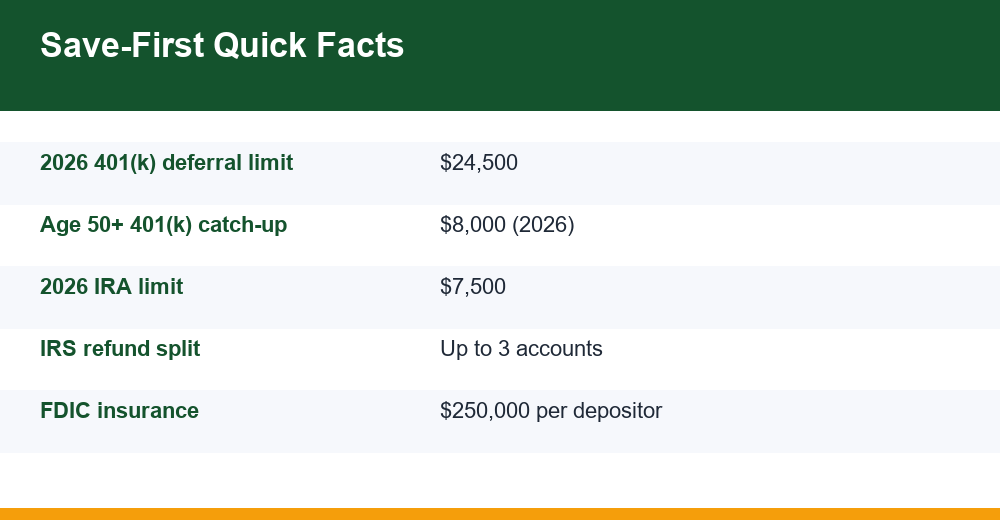
For 2026, the IRS employee deferral limit for 401(k), 403(b), most 457 plans and the federal Thrift Savings Plan is $24,500, up from $23,500 in 2025. Workers aged 50 and older can add an $8,000 catch-up, and those aged 60 to 63 may be eligible for a higher catch-up of $11,250 if their plan allows it. The IRA limit for 2026 is $7,500, with a $1,100 catch-up for people 50 and older.
One newer wrinkle: starting in 2026, workers whose prior-year Social Security wages from that employer topped $150,000 generally must make 401(k) catch-up contributions as Roth (after-tax) money. It does not change how much you can save, only how those extra dollars are taxed.
You do not need to hit these limits to benefit. They simply tell you the ceiling. If you are unsure which account fits which goal, our guide to how 401(k)s, IRAs and Roth accounts work walks through the differences.
How to Automate Your Savings in 7 Steps
Here is a practical sequence. You can finish most of it in one sitting with your bank app and your employer’s payroll portal open.
- Name a goal and a deadline. A starter emergency fund of $500 to $1,000, a car repair cushion, or retirement. A named goal is harder to raid. If you need help framing it, see how to set financial goals you will actually reach.
- Open a separate savings account. Keep it apart from checking, ideally at an FDIC-insured bank. Deposits are insured up to $250,000 per depositor, per insured bank, for each ownership category.
- Check your payroll options. Log in to your employer’s portal or ask HR whether you can split direct deposit across more than one account.
- Set your split or transfer amount. Use the starting point from the table above. A fixed dollar amount is easier to predict than a percentage if your hours vary.
- Time the transfer to payday. If you cannot split deposits, schedule an automatic transfer from checking to savings a day or two after your paycheck usually arrives.
- Enroll in workplace retirement deferrals. Choose a percentage of pay that comes out before the money ever reaches your bank. If your plan offers automatic increases, switch them on.
- Schedule a raise for yourself. Put a calendar reminder every three or six months, and after any pay increase, to move your savings rate up by at least one percentage point.
The Consumer Financial Protection Bureau recommends exactly this kind of setup and notes that automatic transfers work best when timed shortly after payday, while watching your balance so you do not trigger overdraft fees. Its short guide, Looking for an easy way to save money? Make it automatic, is worth a read before you start.
Do not forget your tax refund
A refund is a natural moment to save. The IRS lets filers split a direct-deposited refund across up to three accounts using Form 8888, so you can send part to savings or an IRA before it ever touches checking. Each account must be in your name, your spouse’s name or both.
Raises and windfalls
The easiest money to save is money you have never spent. When you get a raise, bonus or side-gig payment, send at least half of the increase to savings before your lifestyle adjusts to it. Your take-home pay still goes up, and your savings rate climbs without a painful cut.
Split Deposit, Payday Transfer or 401(k): Which Tool Does What
Each automation method suits a different goal. Most people end up using two or three together: payroll deferrals for retirement, a split deposit or transfer for the emergency fund, and occasional windfalls for big goals.
| Method | How it works | Best for | Watch out for |
|---|---|---|---|
| Split direct deposit | Employer sends part of each paycheck straight to savings | Emergency fund, short-term goals | Not every employer offers it |
| Scheduled bank transfer | Your bank moves a set amount on a chosen date | Anyone without a split option | Overdrafts if timing is off |
| 401(k) or 403(b) deferral | Payroll takes a percentage before you are paid | Long-term retirement saving | Early withdrawals can mean taxes and penalties |
| Automatic IRA contribution | Brokerage pulls a fixed amount from checking | Retirement if no workplace plan | Annual limit of $7,500 in 2026 |
| Refund split (Form 8888) | IRS deposits refund into up to three accounts | Once-a-year boost | Only applies to direct deposit refunds |
Split direct deposit
This is the purest version of saving first, because the money never lands in your spending account. Your employer must offer direct deposit and allow the paycheck to be divided between accounts. You usually set it up in the payroll portal or with a direct deposit form listing a second routing and account number.
Payday transfers
If a split is not available, a recurring transfer does almost the same job. Schedule it one or two days after payday so the deposit has cleared. If your pay date shifts around holidays, leave a small buffer in checking.
Payroll retirement deferrals
Pre-tax deferrals into a traditional 401(k) can lower your taxable income now, while Roth deferrals are taxed now but can be withdrawn tax-free later if the rules are met. Either way, the money is taken from your paycheck before you see it, which makes this the most hands-off form of saving.
Under the SECURE 2.0 Act, most new 401(k) and 403(b) plans set up after December 29, 2022 must, for plan years starting in 2025 or later, automatically enroll eligible workers at a rate between 3% and 10%, rising by one percentage point a year to at least 10%. Plans that existed earlier, businesses under three years old, employers with 10 or fewer workers, and church and government plans are exempt. You can always change your rate or opt out.
Should You Pay Yourself First If You Have Debt?
Yes, in most cases, but in a measured way. Throwing every spare dollar at debt can backfire: the first surprise expense goes straight onto a credit card, and the balance you worked to shrink grows again. A small cash cushion breaks that loop.
A common order of priorities looks like this. Treat it as a framework rather than a rule, since interest rates and personal circumstances vary widely.
- Stay current on minimum payments for every debt. Missed payments bring late fees and credit damage.
- Build a starter emergency fund, often $500 to $1,000, so small shocks do not create new debt.
- Capture any employer match. A match is part of your compensation, and skipping it leaves money behind.
- Attack high-interest debt such as credit cards with any extra cash beyond your automatic savings.
- Grow savings again once costly debt is gone, redirecting the old payment into savings or retirement.
During the debt-payoff phase, keep the automatic saving amount modest, perhaps 1% to 3% of take-home pay, and send the rest of your surplus to the debt. The point is to keep the savings habit alive, not to fund large goals yet.
You can automate the debt side too. Set up automatic payments for at least the minimum on each card or loan so a busy week never turns into a late fee, then add a second scheduled payment toward your highest-rate balance.
Low-interest debt is a different story
A fixed-rate mortgage or a low-rate federal student loan does not usually need to be paid off before you save seriously. Many people continue regular payments on those while building retirement savings at the same time.
Is Saving First the Same as a Budget?
Not exactly. A traditional budget assigns every dollar to a category and tracks spending line by line. To pay yourself first, you only need to decide one number: how much goes to savings. Everything left over is yours to spend without detailed tracking. Some people call this a reverse budget.
That simplicity is its strength and its weakness. It works well if your fixed costs are stable and comfortably covered. It struggles if your spending regularly runs past what is left, because you will end up moving savings back to checking.
| Feature | Save-first (reverse budget) | Detailed budget |
|---|---|---|
| Time needed | Low after setup | Ongoing tracking |
| Main decision | One savings amount | Every spending category |
| Best for | Stable income, steady habits | Irregular income or overspending |
| Main risk | Overspending what remains | Burnout from tracking |
The two approaches combine well. Use a simple budget for a few months to learn where your money really goes, then automate savings and loosen the tracking once the numbers are reliable. Our article on practical ways to save money every month covers easy cuts that free up cash for your automatic transfers.
Common Mistakes That Quietly Undo Automation
Automation is powerful, but it is not magic. A classic trap is setting up transfers into savings and then quietly moving the money back out each month. The transfers technically work, but the underlying spending problem never gets addressed.
- Starting too big. An aggressive amount leads to overdrafts and reversals. Start small and step up.
- Keeping savings too close. If your savings account is one tap away from checking, consider a separate bank to add a little friction.
- Ignoring overdraft risk. A transfer that runs before your paycheck clears can trigger fees that cancel out what you saved.
- Never raising the rate. A 2% rate set years ago may now be far below what you could comfortably save.
- Mixing goals in one account. Separate accounts or labeled sub-accounts make it clear which money is for emergencies and which is for a trip.
- Withdrawing retirement money early. Pulling from a 401(k) or IRA before age 59 1/2 usually means income tax plus an additional 10% tax, unless an exception applies.
The fix for most of these is a short quarterly check-in. Review your balances, confirm the transfers are landing, and nudge the amount up if you can. When you pay yourself first and revisit the setup a few times a year, the system keeps working for you long after the initial enthusiasm fades.
This article is educational and not personalized financial advice. Contribution limits and rules are current for 2026; confirm details with your plan administrator or the IRS before acting.
Frequently Asked Questions
What is the simplest way to pay yourself first?
Ask your employer whether your direct deposit can be split between checking and savings, and send a fixed amount to savings each payday. If splitting is not offered, schedule a recurring bank transfer for a day or two after payday. Pair this with a payroll deduction into your workplace retirement plan if one is available.
How much should I save from each paycheck when money is tight?
Start with an amount you can keep up, even $10 to $25 per paycheck or 1% of take-home pay. Consistency matters more than size at the beginning. Once the habit sticks, raise the amount by a percentage point every few months or whenever you get a raise, until you reach your target rate.
Should I save or pay off credit card debt first?
Most people do both. Keep making minimum payments, build a small emergency fund of around $500 to $1,000, and contribute enough to get any employer 401(k) match. Then direct extra cash to high-interest debt while keeping a modest automatic savings transfer running so new emergencies do not go on the card.
Is saving first a replacement for budgeting?
It can replace detailed tracking if your income is steady and your fixed costs are well covered. You choose one savings amount and spend the rest freely. If you often run short before payday, a simple budget for a few months helps you find where money goes so your automatic transfers stop getting reversed.