
Setting clear financial goals is one of the most useful things you can do with your money, because a goal turns a vague wish into a plan you can actually follow. Whether you want to clear a credit card, build a safety cushion, or retire comfortably one day, the method is the same: decide what you want, put a number and a date on it, then break it into small steps. This guide walks you through eight practical steps and how to sort your goals by timeframe.
Table of Contents
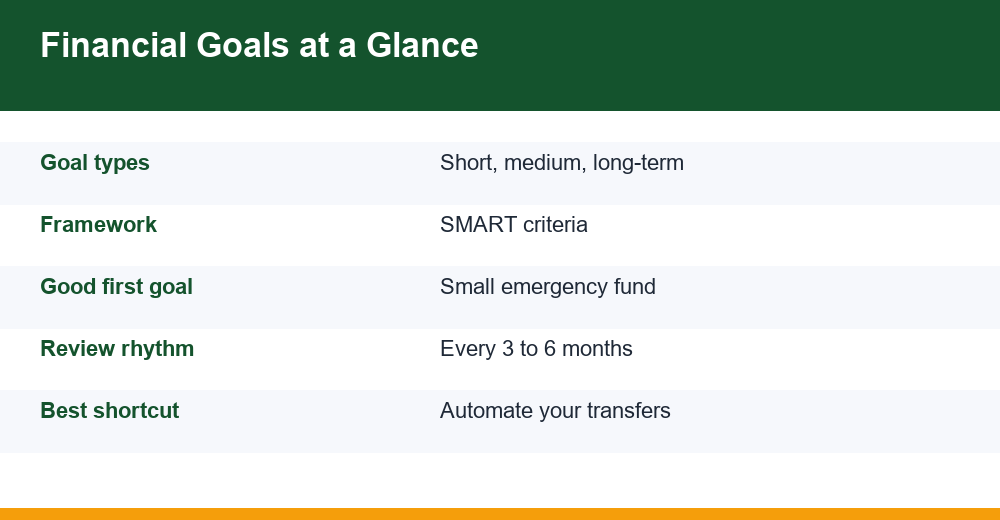
Why Written Goals Beat Willpower
It is easy to promise yourself you will save more or spend less, but those promises rarely survive a busy month. The difference between a wish and real progress is usually structure. A written goal gives your money a job, so the income you earn has a clear destination instead of quietly slipping away on things you can barely remember buying.
Writing a goal down also makes everyday trade-offs easier. When you know you are saving for a home deposit, skipping an impulse buy stops feeling like a punishment and starts feeling like a choice you made on purpose. The steady habits covered in our guide to how to manage money become far simpler once you have something specific to aim for.
You do not need a flawless plan or a spreadsheet full of formulas to begin. You need a clear direction, a realistic number, and the habit of checking your progress often enough to stay honest with yourself. Everything else can be refined as you go along.
There is a quiet confidence that comes from knowing where your money is heading. Instead of wondering at the end of each month where it all went, you can point to something you are building. That sense of control tends to spill over into other choices, making it easier to say no to spending that does not serve your plan.
Short, Medium and Long-Term Goals Explained
Most goals fall into one of three buckets, based on how long they take to reach. Sorting them this way helps you decide where each one should live, because a target you hope to hit in six months and one you are planning for in twenty years call for very different homes for your money.
| Timeframe | Typical horizon | Common examples | Where the money often sits |
|---|---|---|---|
| Short-term | Under 1 year | Starter emergency fund, a holiday, a new phone | Easy-access savings account |
| Medium-term | 1 to 5 years | Car, wedding, home deposit | Savings or lower-risk accounts |
| Long-term | 5+ years | Retirement, a child’s education, financial independence | Long-term or invested accounts |
A starter emergency fund is the goal many people begin with, because it protects every other plan from an unexpected bill. Our walkthrough on how to build an emergency fund is a natural first project before you take on bigger, longer plans.
As a rough guide, money you will need within a year is usually kept somewhere safe and easy to reach, while money you will not touch for many years has more time to weather ups and downs. Matching the timeframe to the type of account is one of the simplest ways to give each goal a fair chance.
Your buckets are not fixed forever, either. A medium-term plan can graduate into a long-term one, and a short-term win can free up room for something bigger. The point of sorting is not to lock you in, but to make sure a plan you need soon is not sitting where you cannot reach it, and a distant plan is not left idle when it could be working harder.
Make Every Goal SMART
Vague financial goals are hard to act on. The SMART method fixes that by pushing you to be specific. Instead of a loose I want to save more, you end up with a target you can measure and mark on a calendar.
- Specific: name exactly what you want, such as a car down payment, rather than just savings.
- Measurable: attach a number so you know when you have arrived, for example an illustrative target of 3,000.
- Achievable: choose an amount your income can realistically reach without leaving you short each month.
- Relevant: make sure the goal truly matters to your life right now, not someone else’s priorities.
- Time-bound: set a deadline, because a date turns a someday wish into this year’s plan.
Working through these five checks takes only a few minutes, yet it changes how a goal feels. A clear figure and a firm date give you something concrete to aim at, and they make it obvious whether you are on track or quietly drifting.
For plain-English background on budgeting and goal setting, the U.S. Consumer Financial Protection Bureau offers free, non-commercial resources at consumerfinance.gov that pair naturally with the SMART approach.
8 Smart Steps to Reach Your Financial Goals Faster
Once you know what you want, the following sequence turns intention into action. You can start today with nothing more than a notebook or a notes app, then refine the details later.
- Take an honest snapshot. List your income, regular bills, debts and current savings so you know your true starting point.
- Write each goal down. Give every goal a name, a number and a deadline, then label it short, medium or long-term.
- Do the simple math. Divide the target by the number of months you have, so you know what to set aside each month.
- Rank them. Decide which goals come first, since you rarely have enough spare cash to chase all of them at once.
- Find the money. Trim a few expenses, redirect a raise, or add some income; our tips on how to save money can free up more than you expect.
- Automate the transfer. Set up an automatic payment into the right account on payday, so saving happens before you can spend it.
- Track your progress. Check in monthly and mark how close you are; visible progress helps keep your motivation high.
- Review and adjust. Every few months, update your numbers as life changes, and celebrate each goal you complete.
If a long-term goal involves investing, remember that the value of investments can rise and fall, and you could get back less than you put in. Give those goals a longer runway, spread your money sensibly, and avoid investing cash you may need in the near future.
None of these steps needs to be done perfectly. The order matters more than the polish, and momentum matters most of all. If you only manage the first three this month, you are still further ahead than you were, and the later steps will feel far more natural once the early habits are in place.
A Sample Goal Plan in Numbers
Numbers make a plan feel real. The table below is an illustrative example only. It uses round, invented figures to show the method, not real rates, guaranteed returns, or amounts you should copy. Your own targets and timelines will depend entirely on your income, your costs, and your priorities.
| Goal | Target amount | Timeframe | Set aside monthly |
|---|---|---|---|
| Starter emergency fund | 1,200 | 6 months | 200 |
| Replace the car | 6,000 | 3 years | 167 |
| Home deposit | 20,000 | 5 years | 333 |
| Retirement top-up | Ongoing | Long-term | 150 |
Turning financial goals into monthly numbers like these is what makes them feel achievable. When a total looks daunting, shrinking it to a weekly or monthly amount almost always makes the next step obvious and far less intimidating.
Notice that the emergency fund here is small and quick, while the home deposit is larger and slower. That contrast is normal. Spreading your effort across different timeframes lets you make visible progress on something soon without losing sight of the plans that take years to complete.
How to Prioritize When Financial Goals Compete
Few of us can fund every plan at full speed, so priority matters. A simple order of operations keeps you from spreading your money so thin that nothing really moves forward.
- Build a small emergency buffer first, so a surprise bill does not send you back to square one.
- Tackle high-interest debt, such as credit cards, because the interest usually costs more than savings earn.
- Claim any free money, like an employer pension match, if one is available to you.
- Then split what remains between your medium and long-term goals in a mix that suits your priorities.
This is a general starting point, not a rule that fits everyone. If you carry a large debt, have an unpredictable income, or support dependents, your order may look different, and that is completely reasonable.
It also helps to revisit your ranking now and then. The goal that felt most urgent in January may matter less by summer, and a change in your income or family can reshuffle the list overnight. Treat the order as a living decision you are allowed to revise, not a promise you are stuck with.
Common Mistakes That Stall Good Plans
Even well-meaning plans can stall for a handful of predictable reasons. Knowing them in advance makes each one much easier to sidestep before it costs you time or momentum.
- Setting too many goals at once. Splitting a small surplus across many targets means none of them moves quickly enough to stay motivating.
- Skipping the emergency buffer. Without a cushion, a single surprise bill can undo months of careful saving and push you toward borrowing.
- Copying someone else’s numbers. A figure that suits a friend or an online example may be quite wrong for your own income and costs.
- Never revisiting the plan. Goals set once and then forgotten tend to drift out of step with a life that keeps changing.
None of these missteps is fatal on its own. The habit that protects you is simple: keep the plan small enough to follow, and revisit it often enough to catch problems while they are still easy to fix.
Staying Motivated When Life Gets in the Way
Progress is rarely a straight line. A quiet month might let you save a little extra, while a costly one might force you to pause. The people who succeed are not the ones who never slip; they are the ones who restart quickly and keep the habit alive.
- Keep your goals visible, on your phone or fridge, so they stay top of mind day to day.
- Celebrate small wins to keep the momentum enjoyable rather than a chore.
- If you fall behind, adjust the timeline instead of abandoning the goal entirely.
- Automate whatever you can, so good decisions happen without daily willpower.
Finally, remember that this article is general educational information, not personalised financial, investment, tax, or legal advice. Everyone’s situation is different, so weigh your own circumstances and consider speaking with a licensed or qualified professional before making any major money decisions.
Frequently Asked Questions
What are the three main types of financial goals?
They are short-term goals under a year, such as a starter emergency fund; medium-term goals of one to five years, like a car or a home deposit; and long-term goals over five years, such as retirement. Sorting goals this way helps you choose where to keep the money for each one.
How many goals should I pursue at once?
There is no perfect number, but many people find two or three active goals manageable. Chasing too many at once spreads your money thin and slows progress. Focus on a single priority, keep one or two others ticking along, and add more as you finish them.
What is the first money goal I should set?
A small starter emergency fund is a sensible first goal for most people. Even a modest buffer stops a surprise bill from derailing everything else and forcing you into debt. Once that cushion exists, you can turn your attention to debt, savings and longer-term plans.
How often should I review my financial goals?
Reviewing every three to six months works well for most people, plus a quick check after any major life change such as a new job, a move, or a new family member. Regular reviews let you adjust the numbers and timelines while the goal still fits your real life.