
Your net worth is one of the simplest and most honest numbers in personal finance: it is everything you own minus everything you owe. It will not fit neatly on a payslip or pop up in your banking app, yet it quietly shows whether you are moving forward or slipping back. The reassuring part is that anyone can work it out in an afternoon, and a few steady habits can nudge it in the right direction for years to come. This article is general education, not personalised advice, and every figure below is illustrative.
Table of Contents
What Is Net Worth, Really?
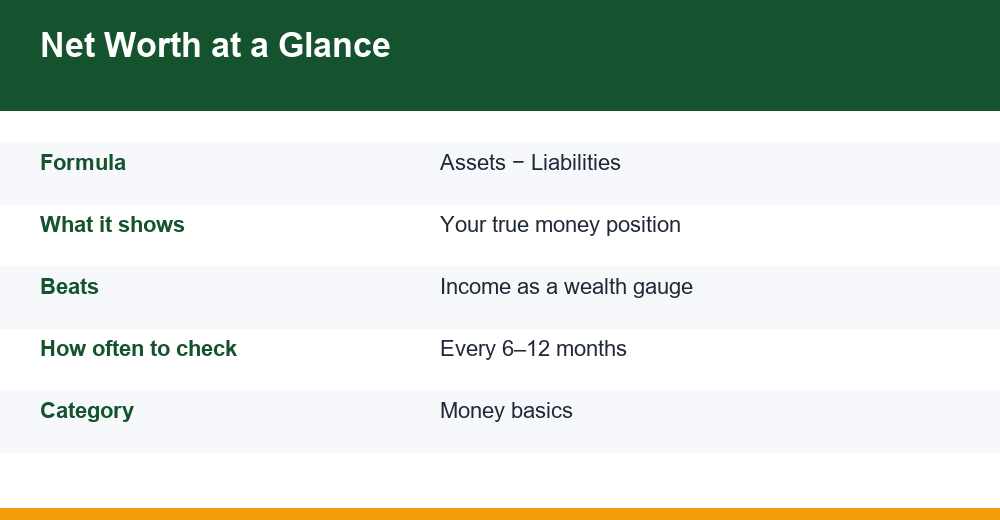
In plain terms, net worth is what you own minus what you owe on any given day. Add up the value of your savings, home, car and investments, take away your debts, and the figure left over is your snapshot. It can be a large positive number, a modest one, or even below zero, and every version is worth knowing.
Think of it as a single photograph of your money life, taken today. Your income is more like a video of what flows in each month, but it says nothing about what you keep. Two people earning the same salary can end up in very different places, and this figure is where that difference finally shows up.
It is also refreshingly personal. You are not chasing someone else’s total; you are simply watching your own move over time. A number that climbs slowly and steadily is doing exactly what you want it to do.
There is nothing mysterious about the idea, either. The same simple subtraction works whether you are twenty-two with a student loan or sixty with a home that is nearly paid off. What changes across a lifetime is the mix behind the number, not the way you work it out, which is what makes it such a dependable measure to return to again and again.
- Assets — anything you own that has real cash value.
- Liabilities — any money you still owe to someone else.
- The gap between the two is your figure, and closing that gap is the whole game.
How to Calculate Yours: Assets Minus Liabilities
The maths is genuinely simple: add up your assets, add up your liabilities, and subtract the second total from the first. The only real effort is gathering honest numbers, so grab recent statements rather than guessing.
Assets are things you could realistically turn into money: cash, savings, retirement accounts, investments, the resale value of your home and car, and valuables worth listing. Liabilities are the debts hanging over you, from your mortgage down to that lingering credit card balance.
| Assets (what you own) | Liabilities (what you owe) |
|---|---|
| Cash and current accounts | Credit card balances |
| Savings and emergency fund | Mortgage or rent arrears |
| Retirement and pension accounts | Car and personal loans |
| Investments and shares | Student loans |
| Home and property value | Buy-now-pay-later balances |
| Car and valuable possessions | Any money owed to family or friends |
Once you have both totals, follow these steps to reach your final figure.
- List every asset with its current, realistic value and add them up.
- List every debt with the amount still outstanding and add those up.
- Subtract total debts from total assets.
- Write the result down, along with today’s date, so you can compare later.
It helps to see the sum in action. Imagine someone with $8,000 in savings, a car worth $6,000 and a home valued at $220,000, giving assets of $234,000. Against that sit a $180,000 mortgage and a $4,000 card balance, which is $184,000 of debt. Subtracting one from the other leaves $50,000. These numbers are purely illustrative, chosen to show the method rather than to suggest any typical or expected result.
That final line is your starting point. It does not need to be impressive; it just needs to be real, because you can only improve a number you are willing to look at. If gathering every balance feels daunting, start with the accounts you check most often and add the rest over a quiet evening or two.
Why Net Worth Matters More Than Income
A big salary feels like success, but income alone can be misleading. Your net worth tells the fuller story because it reflects what you actually keep after the spending, borrowing and saving are done. Someone earning a modest wage with little debt can quietly outrank a high earner who owes a fortune.
That is why it is such an honest measure of progress. It rewards paying down debt, building savings and letting investments grow, rather than simply earning and spending more. It also cuts through lifestyle noise, since an expensive car bought on finance can lower your figure rather than lift it.
There is a quieter benefit, too. Watching this one figure can calm the noise of everyday money worries, because it folds every account, debt and asset into a single line you can act on. Instead of juggling a dozen balances in your head, you get one honest signal that tells you, gently, whether the overall direction is right.
The number becomes far more powerful when you give it a purpose. Rather than watching it drift, connect it to what you are working toward, whether that is a home deposit, a comfortable retirement or simply breathing room. If you have not mapped those out yet, learning how to set financial goals turns a single figure into a plan you can actually follow.
- Income shows what you earn; your figure shows what you have built.
- It highlights debt as clearly as it highlights savings.
- It lets you measure progress against your own past, not other people.
6 Steps to Grow Yours Over Time
Growing your net worth comes down to two levers: increasing what you own and reducing what you owe. Neither has to be dramatic. Small, repeatable moves, kept up over years, tend to do far more than one heroic effort. Here are six steps that work in almost any situation.
- Build a cash cushion. An emergency fund of a few months’ expenses stops small surprises from becoming new debt, protecting everything else you build.
- Tackle expensive debt first. High-interest balances quietly shrink your progress, so clearing them is one of the fastest wins. A clear method for how to pay off debt can help you decide where to start.
- Spend a little less than you earn. The gap between income and spending is the raw material for everything, so protect it and grow it where you can.
- Let long-term money work for you. Putting savings to work through investing gives your money the chance to grow, though investing carries risk, including the possible loss of some or all of your capital. If you are unsure where to begin, a beginner’s guide to how to start investing lays out the basics.
- Grow your income when you can. A raise, a side project or a new skill lifts the whole picture, especially when the extra money goes toward saving or debt rather than new spending.
- Protect what you have built. Sensible insurance and a simple will keep one bad event from undoing years of steady work.
You do not need to master all six at once. Pick the one that fits your life right now, make it a habit, and add the next when you are ready. Because these steps build on one another, early progress tends to make the later ones feel easier rather than harder.
What If Your Number Is Negative?
A figure below zero can feel discouraging, but it is far more common than people admit, and it is often a sign of investment in your future rather than failure. Student loans, a new mortgage or early-career debt can all push the total into the red for a while.
What matters is the direction of travel, not the starting point. A number moving from minus twenty thousand toward zero is real progress, and it deserves the same quiet pride as any positive milestone.
It can also help to break the total into its moving parts. Debt that is steadily shrinking, savings that are slowly growing and investments left to compound all pull in your favour, even while the headline figure is still negative. Watching those smaller trends can keep you going on the days when the big number feels stubborn.
If the total feels stuck or is sliding backward, treat it as useful information rather than judgement. It usually points to one fixable thing: high-interest debt, spending creeping past income, or savings that have not started yet. Naming the cause is the first step to turning it around.
Using Your Number to Guide Decisions
Once you are comfortable calculating it, the real value of your net worth is as a decision-making tool. Before a big purchase, a career change or taking on new debt, you can ask a simple question: is this likely to help the figure grow over time, hold it steady, or set it back? That single lens brings a helpful calm to choices that might otherwise feel overwhelming.
It works best as a compass rather than a scoreboard. The aim is not to obsess over every movement but to keep the long-term trend pointing gently upward, in line with the goals that matter to you. Used that way, the number stops being an abstract statistic and becomes a practical companion to everyday money decisions.
Do keep the tool in proportion, though. It measures money, not meaning, and it cannot capture your health, relationships or the things you value most. A rising figure is worth celebrating, but it is one part of a good life rather than the whole of it.
How Often to Check In and Track Progress
You do not need to watch this figure daily; markets and balances wobble too much for that to be helpful. Checking in every six to twelve months is plenty for most people, ideally on the same dates each year so you are comparing like with like.
Pick a method you will actually stick with. Some people prefer a single spreadsheet with one row per check-in; others like an app that pulls balances together automatically. Either works, as long as you record the same categories each time, because consistency in how you measure matters far more than the tool you happen to choose.
Keeping a simple record turns a one-off calculation into a story you can learn from. The illustrative example below shows how steady saving and debt repayment might move things over three years. These figures are made up for illustration only and are not a prediction or a promise of any result.
| Year | Assets | Liabilities | Result |
|---|---|---|---|
| Year 1 | $40,000 | $55,000 | −$15,000 |
| Year 2 | $52,000 | $47,000 | +$5,000 |
| Year 3 | $68,000 | $38,000 | +$30,000 |
Notice that the result climbs even though the debt is still being paid down; assets are simply growing faster. A free spreadsheet or a basic budgeting app is all you need to keep score. For balanced, ad-free guidance as you go, the U.S. government’s Consumer Financial Protection Bureau offers plain-English tools and articles.
If the trend is upward over a year or two, your habits are working. If it is flat, that is your cue to revisit the six steps and adjust one of them. Try to judge yourself over years rather than months, since the short-term bumps rarely mean as much as they feel like they do in the moment.
Common Mistakes to Avoid
A few habits can quietly distort the picture or knock your motivation. Steering clear of these keeps your figure both accurate and useful.
- Overvaluing your things. Use realistic resale values for your home, car and possessions, not hopeful ones.
- Forgetting hidden debts. Buy-now-pay-later plans and small loans are easy to leave out, but they belong on the list.
- Comparing yourself to strangers. Online averages rarely match your age, location or situation, so measure against your own past instead.
- Checking obsessively. Daily swings mean little; the long-term trend is what counts.
- Chasing risky shortcuts. Promises of fast, guaranteed returns are a warning sign, not an opportunity.
One more trap is worth naming: letting a single bad reading knock you off course. Markets fall, a large bill lands, or an asset is revalued downward, and the number dips. That is normal. A wobble in one snapshot says far less than the shape of the line across several years, so hold any single figure lightly.
Above all, remember this article is general educational information, not personalised financial, investment, tax or legal advice. Your own circumstances are unique, so for decisions that carry real weight it is wise to speak with a licensed or qualified professional who can look at the full picture with you.
Frequently Asked Questions
Is net worth the same as how much money I make?
No. Your salary is income that flows in each month, while this figure measures what you have kept after debts. A high earner with heavy borrowing can have a lower total than a modest earner who saves steadily and owes little.
What should I include as assets?
Include anything with real cash value: bank balances, savings, retirement and pension accounts, investments, and the realistic resale value of your home, car and valuable possessions. Use current market values rather than what you originally paid or hope to get.
Is it bad to have a negative figure?
Not necessarily. Student loans, a fresh mortgage or early-career debt often push the total below zero for a time. What matters most is the direction it moves over the months and years, not the exact starting point today.
How can I grow it the fastest?
There is no guaranteed shortcut, but clearing high-interest debt, spending a little less than you earn, and saving or investing the difference tend to help most. Progress is usually gradual, so consistency matters far more than any single big move.